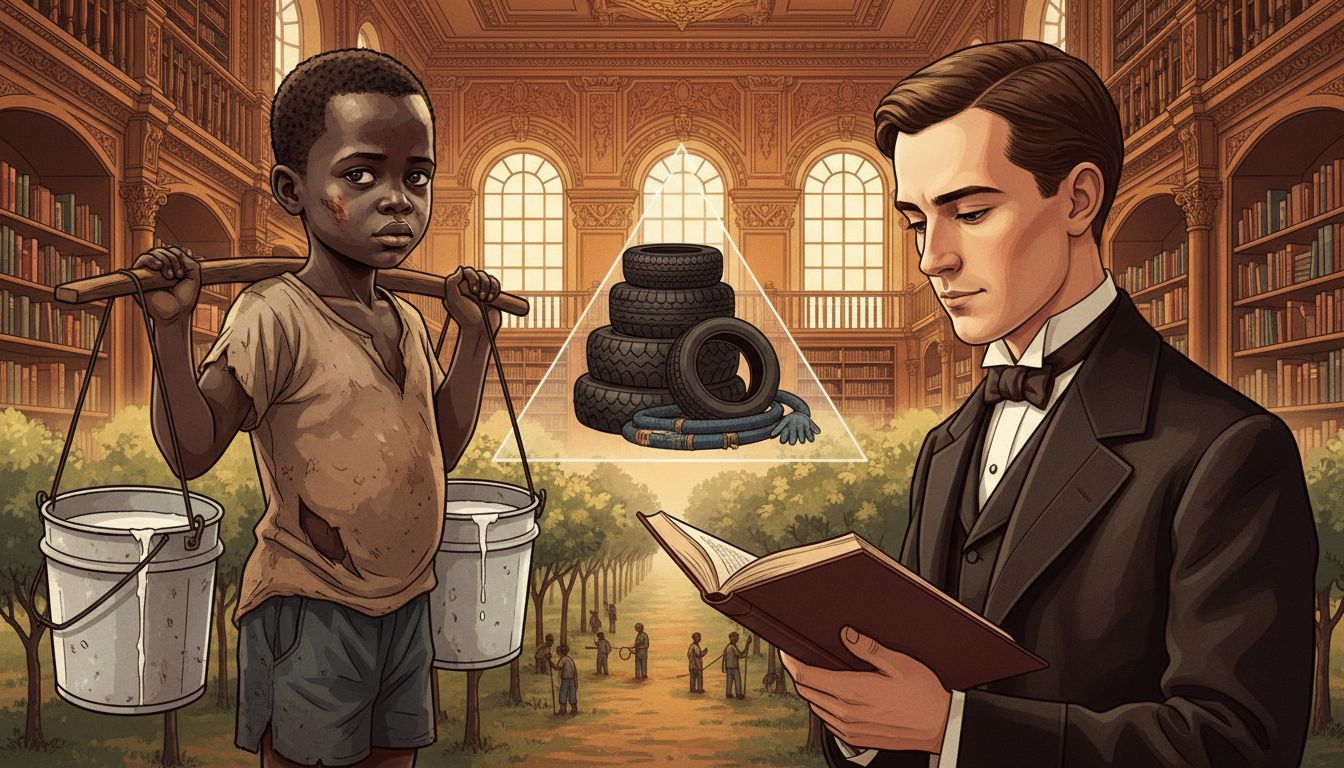
Firestone Liberia: America's Rubber Plantation Empire
How Firestone Tire & Rubber Company transformed Liberia into America's largest rubber plantation through a controversial 99-year lease, creating a corporate colony that exploited workers and shaped a nation's destiny during the global rubber wars.
Act 1
Twenty-One Hours
Six hundred and fifty trees a day, at two minutes per tree. That’s one thousand three hundred minutes. Or more than twenty-one hours of work a day. The math came from Firestone’s own executives, speaking to CNN International in November 2005, trying to defend the company’s labor practices in Liberia. Dan Adomitis, president of a Firestone subsidiary, explained the daily quota. Each tapper will tap about six hundred fifty trees a day, he said, spending perhaps a couple of minutes at each tree. The CNN host, Femi Oke, did the calculation on air. Six hundred and fifty trees a day, at two minutes per tree.
That’s one thousand three hundred minutes. More than twenty one hours of work a day. Twenty-one hours. In a twenty-four hour day. The quota was physically impossible for a single worker. The only way to meet it was with help from your children. A month later, in November 2005, lawyers filed a lawsuit on behalf of twenty three child laborers, ages five to eighteen, representing six thousand plantation workers in total. The complaint used a specific phrase.
Forced labor, the modern equivalent of slavery. The plantation had been operating for seventy-nine years by that point. Almost eight decades. Here’s the central irony. In eighteen twenty two, freed American slaves founded Liberia as a refuge from American racism. They crossed the Atlantic seeking freedom from the plantation system that had enslaved them. A century later, an American tire company established what workers called a plantation on Liberian soil. The Firestone family built the world’s largest rubber operation on land taken from indigenous communities.
They enforced labor quotas with government troops. They paid wages that were one percent of what factory workers earned in Ohio. The company wouldn’t hire Black workers in its Akron factory. But in Liberia, Black workers tapped rubber trees for eighteen cents a day until nineteen fifty. This is a story about corporate colonialism dressed as development. About a nation founded on freedom becoming a corporation’s domain. About forced labor, medical experimentation, environmental devastation, and collaboration with dictators and warlords spanning a century. About an American university that built its library with rubber profits and called it enlightenment.
The plantation still operates today. The ninety nine year lease expires in two thousand twenty five. This year. Nearly a century of documented exploitation. This is the story of Firestone Liberia.
The Rubber War
In the early nineteen twenties, the United States faced what government officials called a strategic vulnerability. Americans owned eighty percent of the world’s automobiles and consumed seventy-five percent of global rubber. But the United States produced exactly one percent of the world’s rubber supply. Britain controlled the rest through colonial holdings in Southeast Asia. The British could strangle the American automobile industry with a single policy decision. Harvey Firestone Sr. understood this. He’d built the Firestone Tire and Rubber Company in Akron, Ohio, into an industrial empire supplying tires for Ford, General Motors, every major manufacturer.
And he had the kind of friends who could help him solve the rubber problem. Between nineteen fifteen and nineteen twenty four, Firestone went on annual summer camping trips through American wilderness with Henry Ford, Thomas Edison, and naturalist John Burroughs. The press called them the Vagabonds. They posed for photographs in the Adirondacks and Appalachia, titans of industry communing with nature, embodying the mythology of American exceptionalism. Firestone told Ford and Edison about his plan to break the British rubber monopoly. He’d find land somewhere tropical. Plant a million acres of rubber trees. Secure American independence.
The U. S. State Department enthusiastically agreed to help. Herbert Hoover, then Secretary of Commerce and future president, supported private corporate solutions to the rubber problem. The government saw Firestone’s venture as a way to maintain American dominance in Latin America and secure spheres of influence globally. This wasn’t just business. It was American corporate imperialism with government backing. In nineteen twenty three, Firestone sent experts to survey potential sites across Africa and South America.
They tested soil samples. Measured rainfall. Calculated labor costs. Liberia met every requirement. The tropical climate was perfect for Hevea brasiliensis, the high-yield South American rubber tree. The soil was rich. And the Liberian government, drowning in foreign debt it couldn’t pay, was desperate for American investment. There was one more advantage Firestone didn’t say out loud.
Liberia was a black republic. Founded by freed American slaves in eighteen twenty two. It had no powerful European protector. Firestone could negotiate terms no European colony would ever accept. Harvey Firestone Sr. never visited Liberia himself. He assigned the project to his eldest son, Harvey Jr., a recent Princeton graduate.
Harvey Jr. had just returned from surveying plantation sites across the globe. In nineteen twenty five, Harvey Jr. recommended Liberia. His father approved the deal. Negotiations began in nineteen twenty four and concluded in nineteen twenty six. What Firestone secured would make Standard Oil’s contracts look generous.
The Concession
The ninety nine year lease. One million acres—ten percent of Liberia’s arable land. Six cents per acre. Firestone also provided Liberia a five million dollar loan at seven percent interest to pay off existing foreign debts. The Liberian government thought this was a lifeline. A way to regain sovereignty from European creditors. It was a trap. The loan consumed twenty percent of Liberia’s total government revenue in nineteen twenty nine.
Thirty two percent in nineteen thirty. Fifty five percent in nineteen thirty one. By nineteen thirty two, the loan payments consumed nearly all of Liberia’s annual revenue. A U. S. legation member calculated the effective interest rate at seventeen percent when opportunity costs were factored in. Firestone had structured a debt trap that would keep Liberia dependent for generations. And there was another provision in the contract.
Buried in the terms. Easy to miss. The Liberian government agreed to encourage, support, or assist Firestone’s efforts to maintain an adequate labour supply. Adequate labour supply. Those three words would enable forced labor for the next five decades. Firestone also proposed building a deepwater port at Monrovia, claiming it was necessary to export rubber. The U. S.
State Department enthusiastically supported the port proposal because it wanted a naval station on the West African coast. But Firestone didn’t actually need the port for rubber exports. The company proposed it purely to secure State Department backing for the concession. When the Liberian legislature reviewed the agreement in nineteen twenty six, some members objected. They saw the terms for what they were. Colonialism dressed as investment. But Liberia’s president, Charles King, pushed the deal through. King owned his own rubber plantation.
So did most of his cabinet. The Americo-Liberian elite—descendants of freed American slaves who’d founded the country a century earlier—would profit from the deal even as indigenous Liberians paid the price. On November nineteenth, nineteen twenty six, the concession was signed. Firestone’s original workforce plan estimated they’d need three hundred fifty thousand workers to cultivate a million acres. That was more than the total number of able-bodied men in Liberia. The company knew voluntary recruitment would never meet those numbers. That’s why they’d included the labour supply clause. The Liberian government would have to force people to work.
Within months, the clearing began.
Act 2
The Displacement
The land Firestone wanted was already occupied. The Bassa people had lived there for centuries. Over a million strong. Distinct villages with houses arranged deliberately to confuse outsiders. Rice farmers, fishermen, traders. They had their own writing system. Ehni Ka Se Fa, a pictographic script rediscovered in the eighteen nineties. Between nineteen twenty six and the early nineteen thirties, they were removed.
Forcibly. Without compensation. In nineteen twenty nine, King Maya Gedebeo of Twansiebo filed a complaint with the Liberian legislature. Nine towns destroyed entirely, he wrote. Communities that had existed for generations erased in months to make room for rubber trees. One group, forced to relocate, named their new settlement Queezahn. In Bassa, the name meant white, civilized, leave this place. They understood exactly what was happening to them.
The clearing proceeded rapidly. Mechanized equipment, American efficiency. The Bassa had maintained spiritual relationships with certain trees, particularly the silk cotton tree. Sacred dwelling places of ancestral spirits that were never to be cut. Firestone’s machines destroyed them all. The displacement wasn’t gradual. It wasn’t negotiated. Communities received orders to move.
Government troops enforced compliance. And the Americo-Liberian elite who ran the government profited from every eviction. President Charles King owned his own rubber plantation. So did most of his cabinet. The descendants of freed American slaves who’d founded Liberia a century earlier were now evicting indigenous Africans to make room for an American corporation’s plantation. The original workforce plan called for three hundred fifty thousand workers. That was more than the total number of able-bodied men in the entire nation. Where would those workers come from?
The labour supply clause in the concession agreement provided the answer. The Liberian government would deliver them. Whether they wanted to come or not.
The Machine
Firestone needed three hundred fifty thousand workers. That was more than the total number of able-bodied men in the entire nation of Liberia. The company knew voluntary recruitment would never meet those numbers. The wages were too low. The conditions were too brutal. The work too dangerous. So the Liberian government built a system to deliver workers whether they wanted to come or not. Chiefs from various ethnic groups—Bassa, Kru, Grebo, Kpelle—were given quotas of workers to provide to Firestone.
The chiefs received compensation based on the numbers they delivered. When voluntary recruitment failed to meet quotas, and it always failed, government officials and the Liberian Frontier Force conscripted workers at gunpoint. Men were removed from their home communities. Families torn apart. Villages depleted of their working-age population. By nineteen thirty, the League of Nations investigation found that of approximately ten thousand laborers on the Firestone plantation, an estimated eight thousand five hundred had not come voluntarily. Eighty-five percent. Eighty-five percent of the workforce had been forced.
Among those notorious for coercion was Allen Yancey, a Firestone contractor who coerced men to prepare land in Maryland county for the plantations without pay. His abuses became so egregious that when allegations emerged in nineteen thirty, Yancey, then Vice-President of Liberia, was forced to resign. The same government officials enforcing labor quotas were profiting from them. Personally. Directly. Some people saw this coming. Raymond Leslie Buell, a Harvard-educated policy researcher and Princeton graduate, published a two-volume study titled The Native Problem in Africa in May nineteen twenty eight. Drawing on firsthand research in Liberia, Buell warned that Firestone’s concession terms were manifestly unfavorable to Liberia and granted without meaningful consultation with indigenous peoples.
His prediction, articulated two years before the League of Nations investigation, was precise. If Firestone proceeds with its plan to cultivate one million acres, he wrote, forced labor and the demoralization of the local populace are unavoidable. This pattern has been observed wherever large-scale plantation systems have been established in Africa. Buell recognized that Firestone’s imperialism surpassed even European colonial powers in its scope. European colonies were at least responsible to European opinion and subject to some form of restraint. Firestone operated with virtually unchecked corporate authority. No oversight. No accountability.
Marcus Garvey, the renowned Pan-Africanist leader and founder of the Universal Negro Improvement Association, became aware of Firestone’s abuses in nineteen twenty eight. He alerted the League of Nations that Firestone was treating its Liberian laborers as virtual slaves. Garvey denounced Firestone as being against the best interests of Liberia, and the natives thereof, and the Negro race at large, for whom the Republic of Liberia was intended. Both Buell and Garvey recognized an ironic tragedy. Liberia, founded in eighteen twenty two as a refuge for free Black Americans and formerly enslaved people seeking autonomy from American racism, had become a site where American corporate capital reproduced the exact slavery and racial exploitation that Liberians had sought to escape. But warnings from academics and activists rarely stop corporations with government backing. By nineteen twenty nine, reports of forced labor scandals reached international attention. High-ranking Liberian officials were forcibly recruiting indigenous people and shipping them to Fernando Po, the Spanish island colony off the coast of West Africa, where they worked as forced laborers on cocoa plantations under horrific conditions.
The League of Nations decided to investigate. What they would find—and what they would choose to ignore—would determine Firestone’s future in Liberia.
The Whitewash
By nineteen twenty nine, reports of forced labor scandals reached international attention. Not just on the Firestone plantation. High-ranking Liberian officials were forcibly recruiting indigenous people and shipping them to Fernando Po, the Spanish island colony, where they worked on cocoa plantations under horrific conditions. Approximately three thousand boys exported annually. The League of Nations established a Commission of Inquiry. The Christy Commission, named for its British chair, Cuthbert Christy. Three members. One American, Charles S.
Johnson, an African American sociologist from Fisk University. One Liberian, Arthur Barclay, a former president. They convened in April nineteen thirty and heard testimony from two hundred sixty four witnesses over several months. The commission’s findings, submitted in September nineteen thirty, were devastating. Liberian government officials had been raiding and forcibly recruiting native boys for shipment to Fernando Po. Recruiters paid government agents, including the president’s own brother, for every laborer delivered. Labor for private purposes was forcibly impressed by the government and used in the Firestone plantations. Workers recruited under conditions of criminal compulsion scarcely distinguishable from slave raiding and slave trading.
But here’s what the League decided. There was no evidence that the Firestone Plantations Company consciously employed any but voluntary labor on its leased plantations. No evidence. This finding was absurd. The company had explicitly requested the labour supply clause in the concession agreement. Firestone management knew the quotas were impossible to meet voluntarily. The League’s own investigation documented that eighty five percent of workers had not come to the plantation willingly. But the League investigation focused on the African government.
Absolved American capital. The scandal forced dramatic changes. President Charles King resigned. Vice-President Allen Yancey resigned. Both took responsibility for the forced labor scandals. Convenient scapegoats. Firestone continued operations without interruption. W.
E. B. Du Bois, the pioneering Black scholar and civil rights advocate, initially supported Firestone’s investment. He saw it as a way to strengthen Liberia’s legitimacy as an independent Black republic. By nineteen thirty three, Du Bois had changed his mind. In an essay published in Foreign Affairs, he wrote his assessment. Liberia is not faultless, Du Bois wrote. She lacks training, experience, and thrift.
But her chief crime is to be black and poor in a rich, white world. In precisely that portion of the world where color is ruthlessly exploited as a foundation for American and European wealth. The success of Liberia as a Negro republic would be a blow to the whole colonial slave labor system. Du Bois understood what the League of Nations wouldn’t acknowledge. Firestone’s exploitation of Black Liberians served the same function as European colonialism. The extraction of resources and labor from African peoples to enrich white capital. The investigation had accomplished exactly what it was designed to accomplish. Blame the African government.
Protect the American corporation. Keep the rubber flowing.
Eighteen Cents a Day
A rubber tapper’s workday began at four in the morning. Firestone implemented what it called the task system. A labor management method with a specific history. When cotton was king in the American South, plantation owners used the task system to organize the work and calculate the value of enslaved people. Firestone applied the identical logic to rubber tappers. Each worker was assigned a daily quota of trees to tap. The task structured the entire day and determined wages. Workers who failed to meet quotas faced wage deductions.
The work itself was brutal. Twelve hours daily, minimum. No safety equipment. No gloves, no goggles, no rain boots. After tapping, workers carried the latex back. Two buckets weighing seventy pounds each. One hundred forty pounds on bare shoulders, often through swampy terrain. For this work, until nineteen fifty, Firestone paid eighteen cents per day.
Let that number sit for a moment. Eighteen cents was less than half of what unskilled laborers earned across colonial West Africa. It was approximately one percent of what a factory worker in Firestone’s Akron, Ohio, plant earned in nineteen forty eight. American workers made one dollar and seventy three cents per hour. Roughly thirteen dollars and eighty four cents per day. One hundred times more than a Liberian tapper. In nineteen fifty one, Firestone’s after-tax profits were three times the entire annual revenue of the Liberian government. Three times.
Workers and their families lived in camps. By two thousand five, documentation showed camps with five hundred people had only two hand pumps for water. During the dry season, these often ran dry. Workers relied on shallow wells and creeks for drinking water. The same water sources where chemical rubber waste from the plantation was dumped. The company applied two hazardous chemicals extensively to protect rubber trees from fungal diseases. Two, four, five T, a dioxin-containing herbicide. Captafol, a carcinogenic fungicide.
Applied without proper safety protocols. Leached into the Du and Farmington rivers. The same rivers where workers bathed their children. Between nineteen forty five and nineteen fifty, workers began to organize. Multiple strikes protesting wages, working conditions, living conditions. After five years of struggle, they won an increase. From eighteen cents per day to twenty eight cents. A forty percent increase.
Still a pittance. But the strikes demonstrated something the company couldn’t ignore. Resistance was possible. And it would continue.
Jim Crow in the Jungle
By the late nineteen forties, fewer than two hundred white managers supervised more than twenty-five thousand Liberian workers. Firestone had transported the American South to West Africa. The plantation hospital was divided into two sections. Upstairs, exclusively for white staff and their families. Modern equipment. Attentive care. Clean facilities. Downstairs, for African workers.
Minimal facilities. Neglect. Overcrowding. The Firestone Overseas Club offered a nine-hole golf course with manicured greens, tennis courts, a swimming pool. Anyone of African descent was barred. Including Liberian government officials. Including diplomats and dignitaries. You could be president of Liberia and you couldn’t play golf at the Firestone Overseas Club.
White managers lived in spacious bungalows. Electricity. Running water. Modern plumbing. Air conditioning. Maids who were paid from workers’ wages. Liberian workers and their families lived in overcrowded camps. By two thousand five, documentation showed camps with five hundred people had only two hand pumps for water.
During the dry season, these often ran dry. Workers relied on shallow wells and creeks for drinking water. The same water sources where chemical rubber waste from the plantation was dumped. Black workers weren’t allowed in Firestone’s Akron, Ohio factory until the nineteen fifties. The company enforced racial segregation at home. But in Liberia, Black workers tapped rubber trees for pennies while white managers lived like colonial overlords. In nineteen fifty four, the U. S.
Supreme Court’s Brown v. Board of Education decision declared school segregation unconstitutional in America. Four years later, in nineteen fifty eight, Liberia passed legislation outlawing segregation within its borders. Firestone refused to desegregate the plantation schools. For four years after Brown v. Board. Not until nineteen sixty two did the schools finally integrate. The logic was clear.
Firestone had exported Jim Crow along with industrial efficiency. The same racial hierarchy that structured American society structured the plantation. White managers on top. Black workers at the bottom. Separate hospitals. Separate clubs. Separate schools. Separate everything.
Liberia was founded in eighteen twenty two by freed American slaves seeking escape from American racism. A century later, Firestone brought that racism back. Packaged as progress. Called it development.
The Medical Ward
In nineteen thirty one, Firestone administered plasmoquine to more than two hundred fifty plantation residents. Plasmoquine was a potentially lethal antimalarial drug. The residents included children. There was no documented informed consent. But what happened in nineteen fifty eight was worse. White researchers at the Firestone Company’s research institute for tropical medicine deliberately infected dozens of Black staff and residents on the plantation with a live strain of malaria. Plasmodium vivax. Imported specifically from Madagascar for research purposes.
Among the victims were two infants. The theoretical justification was deeply racist. Firestone doctors perceived Liberian families living on the plantation as reservoirs for tropical disease, particularly malaria, which threatened the health of white managers. This framework treated African people not as humans deserving of protection but as biological material available for experimentation to safeguard white personnel. Lawsuits later brought against Firestone by injured workers accused the company’s foreign doctors of gross negligence and resorting to unwholesome medical experiments on their African patients while in search of tropical medical knowledge and experience unobtainable in the Americas and Europe. Nineteen fifty eight. The same year Princeton University accepted at least thirteen thousand seven hundred dollars in donations from Harvey Firestone Sr. ’s sons.
Including Harvey Jr. The institute where these experiments occurred was the Liberian Institute of the American Foundation for Tropical Medicine. Harvey Firestone Jr. had personally endowed it as part of his philanthropic initiatives. In nineteen fifty seven, Firestone produced a documentary film titled Medicine in the Tropics. The film showcased research laboratories, disease screenings, and treatment efforts. All framed as humanitarian progress. The same institutions conducting this quote research end quote were simultaneously infecting vulnerable residents with live pathogens.
Firestone’s public relations materials celebrated the medicalization. But the victims—Black Liberian plantation workers, domestic servants, and infants—had no capacity to refuse or report abuse. They were chosen precisely because they were powerless. From the plantation’s inception in nineteen twenty six, Firestone hired Harvard scientists to conduct biological and medical surveys. The nineteen twenty six Harvard expedition documented endemic diseases that threatened labor productivity and the rubber plants themselves. These scientific investigations transformed Liberia’s ecology and economy. And treated human beings as test subjects.
Poisoned Ground
The chemicals had names most workers couldn’t pronounce. Two, four, five T. A dioxin-containing herbicide. Captafol. A carcinogenic fungicide. Firestone applied them extensively to protect rubber trees from fungal diseases. Brown root rot. Black thread.
The chemicals kept the trees healthy. They poisoned everything else. No safety protocols. Workers applied the chemicals without protective equipment. The substances leached into the Du and Farmington rivers. The same rivers where workers drew drinking water. Where children bathed. Where families washed clothes.
Chemical waste from the latex processing plant was dumped directly into sewage systems that emptied into the Farmington River. A two thousand five report documented large volumes of chemical rubbers dumped in the open. No solid waste management system. The forest destruction itself carried spiritual weight. The Bassa, Kru, and other indigenous groups had lived in these forests for centuries. Certain trees held sacred significance. The silk cotton tree, Ceiba pentandra, was understood as a dwelling place of ancestral spirits. These trees were never to be cut.
Firestone’s mechanized clearing destroyed them all. What had been rainforest became monoculture. Rows of rubber trees stretching to the horizon. The spiritual infrastructure of indigenous peoples’ relationship to the land, obliterated. By two thousand five, workers reported that during the dry season, even the hand pumps in camps ran dry. Families relied on shallow wells. Creeks. The same water sources where chemical waste had been dumped for decades.
Skin conditions. Respiratory illnesses. Cancers that appeared with suspicious frequency but were never systematically documented. The company kept no long-term health records for Liberian workers. The environmental devastation served the same logic as the wage exploitation and medical experimentation. Liberian bodies, Liberian land, Liberian water—all were resources to be extracted. Used. Discarded.
The cost was borne by people with no capacity to refuse. The profit flowed to Akron. And Princeton.
Breaking Point
Between nineteen forty five and nineteen fifty, Firestone workers engaged in multiple strikes. They were protesting wages, working conditions, and living conditions. These were significant labor uprisings in a region where unionization was minimal. After five years of struggle, workers won a wage increase. From eighteen cents per day to twenty eight cents. A forty percent increase. Still a pittance. By nineteen sixty three, tensions had reached a breaking point again.
Tens of thousands of Firestone’s Liberian laborers went on strike, protesting the company’s cuts to food subsidies—a critical source of nutrition for impoverished workers. Firestone’s response was violent. The company enlisted Liberian government troops to suppress the strike. At least one worker was killed in the repression. The death of a worker crushing a labor uprising sent a terrifying message. Resistance would be met with lethal force. The strikes ceased only when Firestone reinstated the food subsidies. The Liberian president at the time was William V.
S. Tubman. He served from nineteen forty four to nineteen seventy one. Nearly thirty years of authoritarian rule. Tubman maintained exceptionally close ties with Firestone. When the daughter of a Firestone plantation executive married, the couple honeymooned at Tubman’s summer retreat outside Monrovia. This intimate relationship exemplified the partnership between corporate management and political dictatorship. Under Tubman’s administration, forced labor recruitment continued.
His government used martial law to conscript three hundred thousand casual laborers for Firestone work—maintaining the forced labor system that the nineteen thirty League of Nations investigation had supposedly reformed. In nineteen sixty two, Portugal filed a complaint with the International Labor Organization about Liberian forced labor. Portugal. A country that was itself operating forced labor camps in Angola and Mozambique. Even Portugal recognized what was happening in Liberia as beyond the pale. The complaint finally compelled Liberia to create a labor law outlawing forced recruitment. But by then, Firestone had been operating with forced labor for thirty-six years. And the task system remained.
The impossible quotas remained. The eighteen-cent wages had become twenty-eight-cent wages. While Firestone’s after-tax profits in nineteen fifty one were three times the entire annual revenue of the Liberian government. Workers had won crumbs. Firestone had won an empire.
Tolbert’s Resistance
William Tolbert became president in nineteen seventy one when Tubman died after nearly thirty years in power. Tolbert was different. He saw Firestone’s stranglehold on Liberia’s economy as unsustainable. The company controlled seventy percent of the nation’s wage labor by nineteen fifty. The plantation generated massive profits while most Liberians lived in poverty. Tolbert began pushing back. He renegotiated the concession agreement. Raised taxes on Firestone’s operations.
Demanded more Liberian managers in positions of authority. The company resisted every change. Tolbert also tried to address the Americo-Liberian elite’s monopoly on power. For a century and a half, descendants of freed American slaves had ruled Liberia while indigenous Liberians, the vast majority of the population, remained systematically excluded from government, education, opportunity. This made Tolbert enemies on all sides. The elite saw him as a traitor to his class. The indigenous majority saw reforms as too little, too late. Firestone saw him as an obstacle to profit.
By nineteen seventy nine, riots erupted in Monrovia. The immediate cause was rice prices. The deeper cause was decades of inequality, exploitation, exclusion. Hundreds were killed in the crackdown. Tolbert’s relationship with Firestone grew increasingly fractious. Unlike Tubman, who had honeymooned executives at his personal retreat and conscripted three hundred thousand workers through martial law, Tolbert tried to chart a different course. He believed Liberia could renegotiate its relationship with foreign capital. That the plantation could benefit Liberians, not just American shareholders.
On April twelfth, nineteen eighty, soldiers stormed the executive mansion. Tolbert was killed in his bed. Disemboweled. Thirteen cabinet ministers were tied to posts on the beach and executed by firing squad. The executions were broadcast on state television. One hundred thirty three years of Americo-Liberian rule ended in blood. And Firestone? Within weeks, executives were meeting with the new military government.
Business as usual.
Act 3
The Coup
Samuel Doe was twenty eight years old when he led seventeen soldiers into the executive mansion. A master sergeant in the Liberian army. Indigenous Krahn. Part of the eighty percent of Liberians who had been systematically excluded from power since the nation’s founding. The coup was swift and brutal. Tolbert was killed in his bed. Disemboweled. Thirteen of his cabinet ministers were arrested, tied to posts on a Monrovia beach, and executed by firing squad before television cameras.
The executions were broadcast live. For many indigenous Liberians, the coup felt like liberation. One hundred thirty three years of Americo-Liberian elite rule had ended in a single night. But Doe’s regime was brutal and murderous from the start. Firestone adapted immediately. By May nineteen eighty, barely a month after the coup, Firestone executives traveled to Monrovia to meet with Doe. Don L. Weihe, Firestone’s executive for overseas rubber operations, later described the calculation.
When you’re the big frog in the pond, he said, you’re sort of wondering who is in charge of the pond. Doe understood what Firestone meant to his government. The plantation employed thousands. Generated foreign exchange. Provided revenue the new military government desperately needed. Firestone and Liberia have enjoyed a long and unique historical relationship, Doe declared. We therefore consider this relationship as a contract of survival. A contract of survival.
Not partnership. Not cooperation. Survival. Firestone was not merely a business partner but a guarantor of Doe’s government’s continued existence—providing foreign exchange, employment, and resources that no other entity in Liberia could match. The company had survived a League of Nations investigation in nineteen thirty that found forced labor but absolved American capital. Thirty years of Tubman’s dictatorship, where executives honeymooned at the president’s personal retreat. Tolbert’s attempts at reform, renegotiation, resistance. And now, a military coup that killed the president and executed his cabinet on television.
Firestone didn’t need democracy. It didn’t need stability. It didn’t need human rights or rule of law. It just needed whoever controlled the government to protect the plantation. Doe provided that protection for a decade. And when his regime began to crumble in nineteen eighty nine, when another warlord invaded from Guinea, Firestone would find yet another partner. The pattern was clear by now. The plantation was permanent.
Governments were temporary.
The Warlord
Christmas Eve, nineteen eighty nine. Charles Taylor, an American-educated warlord, led a hundred men across the border from Guinea into Nimba County. The civil war that followed lasted fourteen years. Three hundred thousand people died. Nearly half the population was displaced. Child soldiers, some as young as eight years old. Entire villages wiped out. Systematic rape used as a weapon of terror.
Ethnic cleansing. Cannibalism documented by UN investigators. Liberia descended into a nightmare that shocked even seasoned war correspondents. Firestone stayed. The plantation covered one hundred nineteen thousand acres—the largest industrial installation in Liberia. Modern electrical systems. Communications equipment that actually worked. Paved roads.
Storage facilities. Food warehouses. Medical clinics. As the country collapsed around it, the plantation remained functional. Taylor needed all of it. In July nineteen ninety one, eighteen months into the war, Firestone executives traveled deep into Liberia’s jungles for what ProPublica investigators later called a pivotal meeting. They met with Charles Taylor in person. And they agreed to do business.
By nineteen ninety two, Firestone had signed a formal written agreement to pay taxes to Taylor’s rebel government. Not the internationally recognized government in Monrovia. Taylor’s National Patriotic Front of Liberia. Between nineteen ninety two and nineteen ninety three, Firestone transferred more than two point three million dollars to Taylor’s forces. Cash. Checks. Food supplies. Documented transactions with invoices and receipts.
ProPublica and Frontline’s twenty fourteen investigation documented in meticulous detail how the plantation became military infrastructure for a genocidal warlord. Taylor’s fighters stored weapons and ammunition in Firestone’s warehouses. Used the communications equipment to broadcast propaganda and coordinate troop movements across the country. Taylor himself lived in Firestone housing. The spacious bungalows that white managers had occupied for decades. Electricity. Running water. Comfort.
While Liberian workers still lived in camps with hand pumps that ran dry in the dry season. Years later, testifying under oath in his war crimes trial, Taylor stated that Firestone had been the most significant principal source of foreign exchange for his rebellion in its early years. John Toussaint Richardson, known as J. T., was an American-trained architect who became one of Taylor’s top strategists. He put it more bluntly. We needed Firestone to give us international legitimacy, he said. We needed them for credibility.
A corporation that had survived a League of Nations investigation, decades of documented forced labor, medical experimentation, environmental devastation, and multiple dictatorships had found yet another partner. This time it was a warlord who recruited children to fight and presided over genocide. And the investment continued. While war consumed Liberia, while three hundred thousand people died, while the international community imposed sanctions and embargoes, Firestone invested thirty five point three million dollars in the plantation between nineteen ninety and nineteen ninety three. Expanding operations. Maintaining equipment. Protecting assets. The company wasn’t forced.
It wasn’t coerced. It chose to stay. Because the rubber kept flowing. And profits kept growing.
Abandoned
June nineteen ninety. Taylor’s forces had been advancing through Liberia for six months. Thousands dead. Villages burned. The capital under siege. When they reached the plantation, Firestone had a choice. The company assured all staff they were safe. American managers and their families.
Foreign technicians. Liberian workers who’d spent decades tapping rubber trees. Liberian women who’d cooked and cleaned in white managers’ bungalows. Children born on plantation land. Everyone would be protected, the company promised. Days later, Firestone evacuated only Americans and foreigners. Helicopters came for the white managers and their families. Convoys transported foreign nationals to safety.
Liberian employees—thousands of them—were left behind. The men who tapped rubber trees. The women who’d worked in managers’ homes. The security guards. The maintenance workers. The drivers. The cooks. People who’d given their lives to the plantation.
Abandoned to face Taylor’s fighters. A senior Liberian manager, desperate, sought help from Firestone expatriates he’d worked alongside for years. Colleagues who knew his name, his family, his work. He was turned away. How many Liberian workers and their families died in the violence that followed? No one kept count. No records were maintained. No memorial was built.
When ProPublica and Frontline journalists asked Firestone about the evacuation policy in their twenty fourteen investigation, the company’s written response was carefully worded. We had no choice, the company said. We were forced to work with Taylor under obvious threat of violence. Forced. No choice. But that defense collapses under examination. In nineteen ninety two, two years after abandoning Liberian workers to Taylor’s forces, Firestone signed a formal written agreement to pay taxes to Taylor’s rebel government. Not extortion.
Not coercion. A formal business agreement. The company made transfers totaling two point three million dollars in cash, checks, and food supplies. Documented transactions with invoices and receipts. And between nineteen ninety and nineteen ninety three, while three hundred thousand Liberians died in civil war, while the international community imposed sanctions, Firestone invested thirty five point three million dollars in maintaining and expanding the plantation. You don’t invest thirty five million dollars under threat. You invest when you’re confident in your partnership. When you’re planning for the future.
Firestone chose to stay because the company had always chosen whoever controlled the government. Americo-Liberian presidents who owned rubber plantations and conscripted workers. Tubman, the dictator who ruled for thirty years and hosted executives at his personal retreat. Doe, who seized power in a bloody coup and called Firestone a contract of survival. And now Taylor, the warlord who recruited children to fight and used the plantation as military infrastructure. The governments changed. The methods changed. But the plantation remained.
And Liberian workers continued to tap rubber trees for pennies while their American overlords profited. Some patterns never break. Unless someone breaks them.
Act 4
The Lawsuit
November seventeenth, two thousand five. The International Labor Rights Fund filed a lawsuit under the Alien Tort Statute, an eighteenth-century law allowing foreign citizens to bring claims for violations of international human rights norms. The lawsuit was filed on behalf of twenty three child laborers—ages five to eighteen—representing six thousand plantation workers in total. The lead plaintiff was named Boimah Flomo. The complaint used specific language. Forced labor, the modern equivalent of slavery. A month before the lawsuit was filed, CNN International interviewed Dan Adomitis, president of a Firestone subsidiary. The exchange was remarkable.
Adomitis, defending the company’s labor practices, explained the daily quota. Each tapper will tap about six hundred fifty trees a day, he said, spending perhaps a couple of minutes at each tree. The CNN host, Femi Oke, did the math on air. Six hundred and fifty trees a day, at two minutes per tree. That’s one thousand three hundred minutes. More than twenty one hours of work a day. Twenty one hours. In a twenty four hour day.
Firestone’s own president had just admitted, on camera, that meeting the quota was physically impossible for a single worker. The only way to do it was with help from your children. Two months before the lawsuit was filed—in September two thousand five—Firestone quietly issued a company directive against child labor on the plantation. The timing was not coincidental. The company knew the lawsuit was coming. Documentation from two thousand eight showed the economic reality. A tapper producing latex valued at two thousand two hundred ninety six dollars and eighty cents per month received one hundred twenty five dollars in wages. An eighteen to one ratio between production value and compensation.
The company extracted eighteen dollars in value for every one dollar it paid workers. One worker, anonymous for fear of retaliation, told investigators what it was like. These people are treating us like slaves, he said, because we have nobody to talk for us and we have nowhere to find a new job. You produce more than five tons of latex for the company a month and they don’t even pay you the price of one ton. The case, Flomo v. Firestone Natural Rubber Company, reached the U. S. Court of Appeals for the Seventh Circuit.
In July two thousand eleven, the court issued its ruling. The court found that corporations could be held liable under the Alien Tort Statute. A significant legal precedent. But in this case, the plaintiffs had failed to establish sufficient evidence of forced labor violations. The court’s reasoning was careful. Technical. Legalistic. Children were assisting parents to meet quotas, yes, but they weren’t direct Firestone employees.
The distinction mattered legally. Even though the quota system structurally necessitated child labor. And then came the line that would define the case. The working conditions, the court wrote, while bad, were not that bad. While bad. Were not that bad. Seventy nine years after operations began. Seventy five years after the League of Nations investigation found forced labor but absolved the company.
Six years after Boimah Flomo and twenty two other child workers filed their lawsuit. An American court had looked at the evidence—the twenty one hour quotas, the eighteen to one exploitation ratio, the chemical contamination, the segregated hospitals, the decades of documented abuse—and concluded it didn’t quite rise to the level of slavery. Not that bad.
The Library
The Harvey S. Firestone Memorial Library sits at the heart of Princeton University’s campus. Negotiations for the library began in nineteen forty three. Princeton President Harold W. Dodds wrote to Harvey Firestone Jr. about certain conversations we had about the Library some time ago. They were of a most confidential nature, he wrote. The trustees do not know anything about them.
Princeton desperately needed a new library. Books were stored in dormitories. In the crypt beneath the University Chapel. The university lagged far behind Harvard and Yale. In nineteen forty five, the Firestone family agreed to finance it. The Firestone Tire and Rubber Company’s board, in approving the gift, explicitly stated the library should advance the company’s goal of maintaining its high position in the rubber industry. Princeton would become, in essence, a vocational training institution for Firestone’s benefit. On June sixteenth, nineteen forty seven, the cornerstone was laid.
All five Firestone sons attended. Harvey Jr. remarked that it was a family privilege to have a part in this treasure house of knowledge. The library opened in nineteen forty eight. One million dollars. Designed to hold two million volumes. It became the physical embodiment of academic aspiration—where generations of Princeton students would study, research, build their futures. The library was funded by rubber tapped by workers earning eighteen cents a day.
But the library was just the beginning. Harvey Firestone Jr., Princeton class of nineteen twenty, served as a university trustee for thirty years. Between nineteen twenty and nineteen eighty one, the Firestone family made more than one hundred fifty donations to Princeton. Cash gifts. Company stock—twenty four thousand shares transferred between nineteen forty six and nineteen seventy two. Endowed professorships. Scholarships.
Student housing. Chapel pews. Gymnasium equipment. The donations touched every aspect of Princeton. From bookshelves to barbells. They totaled three point five eight million dollars by nineteen seventy. Approximately thirty nine million in today’s currency. By nineteen seventy, the Firestones had given or pledged one dollar of every hundred in Princeton’s endowment.
Princeton President Harold W. Dodds, speaking at a university event, praised the family’s generosity. Wherever the name of Firestone is heard, he said, warmth and enlightenment are sure to abound. Warmth and enlightenment. But Princeton knew. In nineteen twenty eight, Raymond Leslie Buell, a Princeton graduate who’d earned his PhD there in nineteen twenty three, published a two-volume warning. His study documented that Firestone’s concession terms would inevitably produce forced labor and the demoralization of Liberia’s people. Published two years before the League of Nations investigation confirmed it.
Princeton stayed silent. By nineteen thirty three, W. E. B. Du Bois had denounced Firestone’s exploitation. Princeton stayed silent. In the late nineteen sixties, when Black students at Princeton demanded the university divest from apartheid South Africa, Princeton’s administration refused. Investment in South Africa was necessary, they argued, to maintain the university’s financial health.
At the same time, Princeton strengthened its ties with Firestone—one of South Africa’s largest tire manufacturers, a corporation that had exported Jim Crow segregation to Africa decades before apartheid was formalized. The university prioritized corporate relationships over moral reckoning with racial injustice. In nineteen fifty eight, the same year Princeton accepted at least thirteen thousand seven hundred dollars from Harvey Firestone Jr. and his brothers, white researchers at Firestone’s medical institute in Liberia deliberately infected dozens of Black workers with live malaria. Including two infants. The institute conducting those experiments was personally endowed by Harvey Jr. His philanthropic work. Princeton celebrated him as a benefactor.
Named its library after his father. Accepted over one hundred fifty donations. Never once publicly acknowledged where that wealth came from. The library still stands. The name remains. Warmth and enlightenment.
What Remains
Today, the plantation still operates. A Japanese tire manufacturer called Bridgestone Corporation acquired Firestone in nineteen eighty eight and now runs the Liberian plantation as a subsidiary. The company’s official website describes itself as a trusted partner of the people and country of Liberia for more than ninety years. Ninety years. In August two thousand eighteen, unions representing over ten thousand agricultural and industrial workers demanded living wages, better housing, safe drinking water, and electricity. Basic necessities. Not luxuries. Firestone’s managing director claimed workers earned eight dollars and thirty six cents per day.
The actual minimum wage the company paid was five dollars and sixty cents. A thirty three percent discrepancy between what the company claimed publicly and what workers actually received. In two thousand nineteen, Firestone converted approximately two thousand direct employees to third-party agency contracts. This shift eliminated those workers’ access to union representation and collective bargaining rights. The same tactics American corporations use domestically to avoid accountability, now deployed in Liberia. In April two thousand seven, police brutalized striking plantation workers who were protesting Firestone management’s efforts to delay independent union elections. Dozens of workers were injured. At least one died from wounds sustained in the attack.
The ninety nine year lease expires in two thousand twenty five. This year. Nearly a century. From nineteen twenty six to two thousand twenty five, the documentation is unambiguous. Forced labor. Medical experimentation. Jim Crow segregation. Wages that were one percent of what American workers earned.
Child labor impossible to avoid given the quotas. Collaboration with dictators and warlords. Environmental devastation. Chemical poisoning of water sources. A League of Nations investigation in nineteen thirty found forced labor but absolved the American company. A lawsuit in two thousand five documented ongoing exploitation, established important legal precedent, but failed to secure compensation for workers. An American court looked at the evidence and concluded the conditions, while bad, were not that bad. No meaningful accountability.
No reparations. No justice. The story is not historical. It is ongoing. In eighteen twenty two, freed American slaves founded Liberia as a refuge from American racism. They crossed the Atlantic seeking freedom from the plantation system that had enslaved them and their ancestors. A century later, an American corporation established what workers called slavery on Liberian soil. The same logic that built the cotton South was exported to Africa.
Firestone wouldn’t hire Black workers in its Ohio factory until the nineteen fifties. But in Liberia, Black workers tapped rubber trees for eighteen cents a day. The rubber became tires for American automobiles. The profits built Princeton’s library. Princeton called it warmth and enlightenment. American slavery didn’t end in eighteen sixty five. It was internationalized. The Firestone plantation in Liberia demonstrates that corporate capital found ways to reproduce the exploitation that abolition was supposed to end.
The methods changed. The location moved. The justifications evolved. Progress. Development. Partnership. But the extraction of Black labor for white profit remained constant. The plantation still stands.
The library still bears the Firestone name. The company still calls itself a trusted partner. Boimah Flomo, the lead plaintiff in the two thousand five lawsuit, fought for justice for six years. He represented twenty three children and six thousand workers. The case established that corporations could be held liable for human rights violations. But it didn’t win compensation for the workers who tapped rubber until their hands bled. Somewhere in Liberia, right now, a worker is tapping rubber trees before dawn. Carrying seventy-pound buckets on bare shoulders.
Drinking from contaminated water sources. Living in camps that flood during the rainy season. The ninety nine year lease expires this year. What happens next will determine whether a century of exploitation finally ends. Or whether it simply continues under a new agreement. The rubber still flows. The profits still grow. And the workers still wait for justice.