Fordlandia: Henry Ford's $20 Million Amazon Disaster
In 1927, Henry Ford tried to build an American utopia in the Brazilian Amazon. White picket fences, square dances, and fire hydrants from Michigan—all transplanted into the world's most untamed jungle. What he got was worker riots, ecological collapse, and a $20 million ghost town. This is the story of Fordlandia.
Act 1
What the Jungle Swallowed
Today, deep in the heart of the Brazilian Amazon, there is a ghost that refuses to die. If you push through the vines, you’ll find white picket fences. You’ll find fire hydrants made in Michigan. You’ll find the ruins of a state-of-the-art hospital where cattle now graze in the hallways. This isn’t just a lost city. It was a 20-million-dollar experiment. A piece of Dearborn, Michigan, transplanted into the most untamed wilderness on earth. Fordlandia was becoming a symbol of American arrogance—a place that took everything from the land and gave nothing back but a gridded town and a clock that nobody wanted to follow. We’ll get back to how it all fell apart… but first, we have to understand the man who thought he could conquer the jungle with a machine.
The Dream Emerges
In 1925, the American dream was running on four wheels. But those wheels had a secret, terrifying weakness. They were made of rubber. And rubber? Rubber didn’t belong to America. It’s July. A humid, heavy afternoon in Michigan. Henry Ford—the man who had effectively invented the modern world—is having lunch with his close friend Harvey Firestone. Firestone is visibly shaken. He’s just received a dispatch from London. Winston Churchill, the ambitious Chancellor of the Exchequer, has proposed a policy that sounds to these two men like a declaration of economic war: The Stevenson Plan. A British rubber cartel. For decades, the British had held a stranglehold on the sap of the Hevea brasiliensis tree. It was one of history’s greatest heists. In 1876, a man named Henry Wickham had smuggled 70,000 seeds out of the Brazilian Amazon under the very noses of the authorities. He took them to Kew Gardens in London, and from there, they were shipped to the East. Massive, orderly plantations rose in Asia, and the Brazilian rubber boom—once the wealthiest, most decadent trade in the world—collapsed into dust. Now, Churchill wanted to use that monopoly to squeeze America. The price of rubber had plummeted, and the British were restricting production to drive it back up. Herbert Hoover, the Secretary of Commerce, was furious. He called it “extortion.” He urged American manufacturers to find their own supply. To plant “rubber under an American flag.”
Most corporate leaders shrugged. They were content to pay the price and pass it to the consumer. But Henry Ford? Ford didn’t like being told what to do. He didn’t like middle-men, and he certainly didn’t like Winston Churchill. He wanted total, absolute, vertical control. He envisioned a world where he owned the mines that produced the iron, the forests that provided the wood, and the plantations that bled the rubber. If the British had stolen the seeds from the Amazon to build their empire… Ford would go back to the source to build his. He would return to the jungle. But he wouldn’t just bring money. He would bring the assembly line. He would bring Michigan to the Equator.
The Visionary
To understand why Henry Ford went to the Amazon, you have to understand who he was in 1925. He wasn’t just a businessman. He was a philosopher of the machine. He was the man who had effectively abolished the 19th century. He had invented the ‘Five Dollar Day,’ nearly doubling the average industrial wage. It was a revolutionary gamble. If his workers could afford to buy the cars they built, he created a self-sustaining loop of consumption. But that money came with a price. He created the Sociological Department—a private army of investigators who monitored his workers’ lives. They checked their bank accounts. They checked if they were drinking. They even checked if their homes were clean. Ford believed that if you applied the principles of the assembly line to human behavior, you could eliminate poverty, vice, and even war. This was a man who hated war as much as he hated inefficiency. In 1915, he had chartered a ‘Peace Ship’ to Europe, convinced he could talk the leaders of the Great War into sense. He told a reporter, “We’re going to try to get the boys out of the trenches before Christmas.” It was a spectacular, public failure. The world mocked him. Theodore Roosevelt called his stance ‘treacherous.’ But Ford didn’t care. He doubled down on his own brand of ‘Absolute Americanism.’
Ford had no time for traditional history. He famously said, “History is more or less bunk.” He didn’t build libraries; he built factories. He called reading a ‘dope-habit.’ But he found his confirmation in Ralph Waldo Emerson. He believed mechanization wasn’t the enemy of nature—it was its fulfillment. In his mind, a tractor was more beautiful than a horse, and a factory was more spiritual than a cathedral. By the mid-1920s, his vision was becoming even more radical. He wanted to synthesize the farm and the factory. “The cow must go,” he declared. He wanted cars grown, not mined. Plastic panels made of soy. Oil made of soy. Food made of soy. He bought tens of thousands of acres in Michigan to build ‘Village Industries’—small, mechanized towns where workers would farm in the summer and build car parts in the winter. He tried to take this vision south, to Muscle Shoals, Alabama. He proposed a hydroelectric utopia that would stretch for 75 miles, abolishing poverty with the power of the Tennessee River. But the politicians in Washington blocked him. They feared he was becoming too powerful—a shadow government in a three-piece suit. Ford walked away, bitter and disillusioned. He was looking for a place where his word was law. A place where there were no politicians, no unions, and no experts to tell him ‘no.’
And then, he heard about the Amazon.
The Grand Plan
His secretary, Ernest Liebold, found the canvas. The Amazon. It was the only place that made sense. It was the birthplace of rubber. For centuries, the ‘black gold’ had been harvested by tappers in the wild—men living in debt-peonage, struggling against a jungle that wanted to swallow them whole. The Brazilian rubber boom had collapsed when those stolen seeds reached Asia, leaving behind ghost towns like Manaus with its empty opera house and its faded Parisian dreams. In 1925, Brazil was desperate. They saw in Ford not just a businessman, but a ‘Moses of the twentieth century.’ They offered him land. Not a plot. Not a farm. An expanse larger than the state of Delaware. 2.5 million acres in the heart of the Tapajós River valley. Ford didn’t send surveyors. He didn’t send botanists to check the soil. He didn’t listen to the experts who warned that the Amazon’s ecosystem was a complex web that couldn’t be tamed like a Michigan cornfield. He simply saw a map. And on that map, he saw the future of his empire. While Henry Ford was dreaming of rubber, a man named Jorge Dumont Villares was dreaming of Ford. Villares was a political chameleon who saw in Ford a golden ticket. He didn’t just offer land; he offered a vision of ‘Fordville’ and ‘Edselville’—modern cities rising from the silt, complete with schools, hospitals, and cinemas. He told Ford exactly what he wanted to hear: that the land was fertile and the path was clear. In June 1927, Ford sent his first delegation. O.Z. Ide, a straight-laced accountant, and W.L. Reeves Blakeley, a man chosen for his ‘energy’ rather than his experience. Their mission was to negotiate the final concession with Governor Dionysio Bentes. The deal was struck with a speed that would have been impossible in the United States. No environmental impact studies. No public hearings. Just a signature and a promise. Ide sent a telegram back to Dearborn that would become the project’s epitaph: “Everything jake. Sailing tonight.”
But there was one more report. Carl D. LaRue, a botanist who actually knew the Amazon, was sent to verify the site. LaRue’s report was a terrifying duality. He praised the vegetation, yes… But then, he looked at the people. He described a ‘Dickensian misery.’ He found a population ravaged by malaria and hookworm, trapped in a cycle of debt. He saw children who had never played and men who had never known a fair wage. “They will all die,” the report whispered. Ford called it Fordlandia. It wasn’t just a plantation. It was a 20-million-dollar civilizing mission. He would teach the Amazon the Ford way of thinking. He would build a town with white picket fences and ice cream shops in the middle of a world where nature had been the only master for ten thousand years. But the Amazon isn’t a factory floor. And as the first steamships began their journey up the river, loaded with American lumber and American dreams, the jungle was already waiting.
Act 2
Breaking Ground
In the heart of Brazil, two giants meet. The Amazon, a silt-heavy brown, and the Tapajós, a deep, clear blue. To Henry Ford, this wasn’t just geography. It was a metaphor. American industrial logic meeting the raw, chaotic potential of the wild. Ford’s solution to the logistics of the jungle was his favorite tool: industrial recycling. He took decommissioned ships, stripped them for parts, and rebuilt them for the tropics. The Lake Ormoc was the flagship—a floating piece of Dearborn. Inside its iron hull were steam shovels, generators, a state-of-the-art laboratory, and even a fully equipped hospital. In July 1928, the fleet set sail. But the river didn’t care about Ford’s schedule. No one in Dearborn had bothered to check the seasonal water levels of the Tapajós. They arrived during the dry season, and just outside the port of Santarém, they hit a barrier no engine could overcome: a massive rock ledge buried beneath the surface. The ships, built for the deep Great Lakes, were stranded. They spent months stuck on sandbars, the equator sun warping the very metal of the decks. It was the first lesson the Amazon taught them: In this world, the river dictates the time. And Ford’s clock was already running slow. The man Ford sent to lead this conquest was Reeves Blakeley. He wasn’t a botanist. He wasn’t an engineer. He was a man of ‘energy’—which, in the Ford empire, often meant a man of iron-fisted authority. Blakeley ran Fordlandia like a battleship. When they finally reached the site at Boa Vista, they didn’t just clear the land. They declared war on it. Against the advice of everyone who knew the region, Blakeley ordered the jungle cleared during the height of the rainy season. The wood was too wet to burn, so they doused it in thousands of gallons of kerosene. The resulting fires were so intense they were visible for miles. Wildlife fled in terror. The smoke was so thick it choked the lungs of the workers and turned the midday sun into a ghostly, red orb. Blakeley ruled from a comfortable, screened-in cabin, while his thousands of laborers—men recruited from the poverty-stricken coasts of Brazil—slept in the mud and ash. The result wasn’t a plantation. It was a hellscape. The cleared land, stripped of its canopy, became a wasteland of stagnant pools. Those pools became nurseries for the Anopheles mosquito. Malaria swept through the camp like a scythe. Men collapsed in the rows. Infection and dysentery followed. Blakeley’s response wasn’t medicine or sanitation—it was discipline. He ignored the overflow garbage. He ignored the lack of clean water. He believed that the ‘Ford Way’—order, speed, and obedience—was more powerful than the jungle’s diseases. He was wrong.
The Honeymoon Period
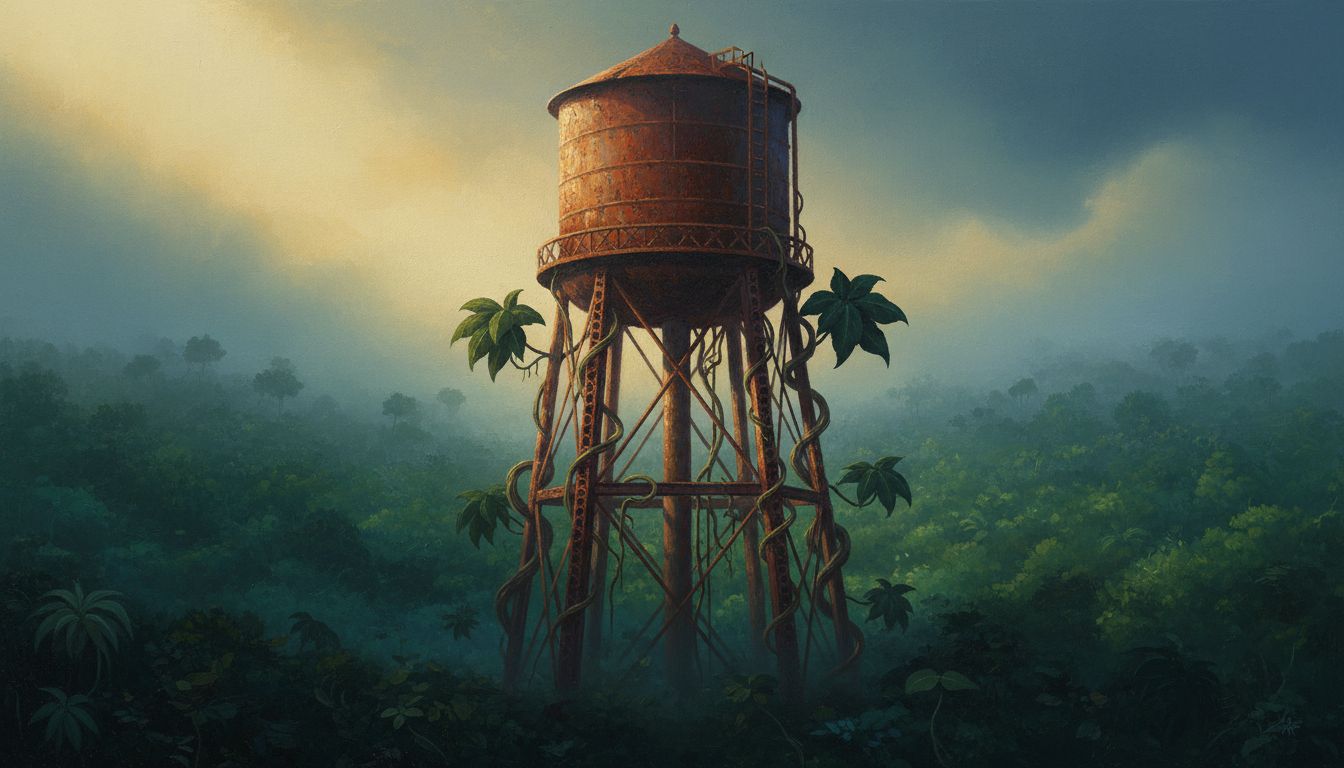
By 1929, the fires had died down, and a miracle of American engineering began to emerge from the mud. Gridded streets. Streetlights. Fire hydrants. To the outside world, Fordlandia was a triumph. A ‘Model City’ that proved American civilization could take root anywhere. They built a slice of the Midwest in the tropics. Beautiful, clapboard houses with manicured lawns and cement sidewalks. There was a nine-hole golf course. A movie theater that showed the latest Hollywood releases. Every Saturday night, the company organized square dances. They even had a 150-foot water tower, visible for miles, bearing the blue Ford oval like a beacon of progress. But the ‘honeymoon’ was a waking fever dream. The houses had been designed by engineers in Dearborn who had never seen the Amazon. They decided that metal roofs were more ‘modern’ than traditional thatch. One priest who ministered in the town recalled that these homes were “hotter than the gates of hell.” Inside, the air was stagnant, and the heat was a physical weight that made sleep impossible. Ford’s moral code followed the workers into the jungle. Prohibition was enforced. No alcohol. No gambling. No ‘immoral’ behavior. Even the food was regulated—traditional Brazilian staples like beans and rice were replaced by a ‘scientific’ diet of whole-wheat bread and canned goods. The workers, of course, found a way. Just eight kilometers upstream, a small, lawless settlement grew on a strip of land the Americans called the ‘Island of Innocence.’ It was anything but innocent. It was a neon-lit oasis of bars, nightclubs, and brothels that operated just beyond Ford’s jurisdiction. Workers would paddle out at night, hiding bottles of cachaça inside hollowed-out watermelons to smuggle back into the camp. Under the construction head, Archilaus Weeks, the city’s skeleton continued to grow. A massive sawmill turned the ancient mahogany of the jungle into lumber for more American houses. A power plant provided electricity for the streetlights. But the tension was simmering. To the American managers, the Brazilians were ‘lazy’ and ‘inefficient.’ To the Brazilians, the Americans were autocrats who didn’t understand the land. They were building a city, yes… but they weren’t building a community. They were building a pressure cooker.
Cracks in the Foundation
By 1929, Fordlandia was no longer just a dot on a map. It was a destination. But for the families who came there, the journey was a trial by fire. Take the Perini family. Victor Perini, an expert in wood and logistics, was recruited personally by Henry Ford. He and his wife Constance arrived in the wake of a hurricane, their ship delayed, their spirits dampened before they even stepped off the gangplank. Victor looked at the “city” he had been promised and saw only developmental chaos. There were no houses for the Americans yet. No schools. No roads. Just mud, stumps, and the relentless, deafening sound of the jungle. For the American workers, the Amazon wasn’t an adventure anymore. It was a cage. The isolation was profound. Mental health began to fracture under the weight of the heat and the silence. Loneliness turned into a sense of captivity. Anxiety and mood swings became as common as malaria. Men who had once dreamed of “upward mobility” now found themselves begging to go back to Detroit. Some, like the lumberjack Matt Mulrooney, found a dark humor in the absurdity. He framed the disarray as a game. But for most, the “new industrial feudalism” was becoming a nightmare. Even those sent out to save the plantation were losing their grip. Johansen and Tolksdorf were dispatched into the deep interior to gather rubber seeds. But their expeditions looked more like scenes from Heart of Darkness than a corporate mission. They drank to forget the isolation. They abandoned their duties. They treated the indigenous Mundurucú people not as guides, but as a “workforce” to be exploited. But while the humans were fracturing, the trees were dying. Henry Ford believed in “Standard Practices.” In Michigan, he planted trees in straight, orderly rows. He did the same in Fordlandia. But in the Amazon, the rubber tree is a solitary creature. In the wild, they grow hundreds of yards apart to hide from their predators. By huddling them together in massive, industrial groves, Ford had created an all-you-can-eat buffet for the Microcyclus ulei—the South American Leaf Blight. Reeves Blakeley, the autocratic first manager, was finally fired for his incompetence. In his place, Ford sent Einar Oxholm. Oxholm was honest, but he knew even less about tropical plants than Blakeley did. He dismissed the experts. He ignored the warnings of the botanists. He believed, like Ford, that “common sense” was more valuable than science. The cracks were no longer just in the management. They were in the soil itself. The dream was literally rotting from the outside in.
Mounting Tensions
In December 1930, they finished the tower. It was a beacon of industrial pride. But beneath its shadow, a new kind of tyranny was being implemented. The Americans brought with them a concept the Amazon had never known: ‘Industrial Time.’ In this world, time had always been governed by the sun, the rain, and the rhythms of the seasons. But in Fordlandia, time was governed by the whistle. A sound so loud it could be heard seven miles away. Time clocks were installed in the middle of the jungle. Workers were required to punch in at 7:00 AM sharp and out at 4:00 PM. To the American managers, the locals were ‘lazy’ because they wanted to rest during the blistering 100-degree heat of mid-day. They didn’t understand that for a thousand years, the people of the Amazon had survived by working with the sun, not against it. Ford management wanted to regulate every aspect of a worker’s existence—including what they ate and how they ate it. They replaced the traditional waiter service with a cafeteria-style system. For the skilled Brazilian laborers—the masons and carpenters—this was a profound loss of dignity. Being forced to line up like cattle for their food was an insult they wouldn’t forget. And then there was the menu. Henry Ford, a health fanatic, had banned alcohol and tobacco. He mandated a ‘scientific’ diet of ‘wholesome’ American food. Gone were the beans, the manioc, and the fresh fish from the river. Now, it was oatmeal, brown rice, and canned goods from Michigan. One manager, Kaj Ostenfeld, was particularly hated for his rigid enforcement of these rules. But there was a shift in the air. In October 1930, a revolution had swept across Brazil, bringing Getúlio Vargas to power. The old hierarchies were crumbling. The workers in Fordlandia heard the news. They felt a new sense of autonomy—a feeling that they didn’t have to take orders from ‘gringos’ who didn’t respect their culture. The tension wasn’t just building; it was reaching a boiling point. The Americans saw themselves as teachers, but the Brazilians saw them as jailers. The factory whistle, once a symbol of progress, now sounded like a countdown. They were waiting for a spark.
Act 3
The Breaking Point
The breaking point didn’t come from the heat, the malaria, or the relentless rain. It came from the clock. The Brazilian workers were used to the natural, fluid rhythms of the equator. They measured time by the sun’s height and the river’s flow. But Ford brought the whistle. A sound that tore through the silence of the forest for seven miles. Punching time cards. Clocking in. Clocking out. To the managers, it was efficiency. To the workers, it was a slow, daily dehumanization. On a Tuesday in December 1930, the pressure cooker finally exploded. The catalyst was the dining hall. The manager, Kaj Ostenfeld, was the most hated man on the plantation—the embodiment of Ford’s rigid, joyless discipline. When the workers entered the cafeteria and were told they had to line up and wait for their bland American food, the air in the room changed. A single worker—a man who had had enough of the ‘Ford Way’—pushed back. He threw his tray. He shouted a challenge. And then, the room ignited. “Kill all the Americans!” It was a cry that didn’t just stay in the dining hall. It swept through the town like a wildfire. They didn’t just riot; they performed a ritual of destruction. They targeted the symbols of their captivity. They smashed every time clock on the plantation. They chopped up the trucks with machetes. They threw the cafeteria equipment into the river. They even tore down the fences. The American managers, paralyzed by terror, fled. Some hid in the jungle, but most scrambled onto the Lake Ormoc, pulling up the gangplanks as the workers reached the shore. For days, the Americans watched from the safety of the iron ship as their ‘model city’ was dismantled. The riot was eventually suppressed by the Brazilian military. Order was restored at the point of a bayonet. But the spell was broken. Henry Ford’s name, once used like a protective amulet by the locals, was now a curse. You could transplant the factory, but you couldn’t transplant the soul of Detroit into the heart of the Amazon. The jungle had won the first round.
Aftermath
While Fordlandia was rioting, the city that built it was dying. The Great Depression had arrived. Car production in Detroit plummeted from five million units a year to less than two million. Henry Ford, the man who claimed his system would abolish poverty, now watched as his own workers descended into hunger and crime. His response to the collapse of his modern world was a retreat into the past. He began to distrust the very consumer society he had created. He spent millions building Greenfield Village—a nostalgic theme park of a pre-industrial America. It was a profound irony: the man who had destroyed the 19th century was now desperately trying to buy it back. Henry Ford’s response to the crisis wasn’t more innovation. It was Harry Bennett. Bennett was a street fighter turned corporate enforcer. He ran the Ford Service Department—a private army of goons and ex-cons who patrolled the Detroit plants with clubs. For years, Ford had successfully crushed any whisper of unionization through fear. But in 1940, the power dynamics shifted. Getúlio Vargas, the populist dictator of Brazil, visited the plantations. Vargas wasn’t there to congratulate Ford. He was there to claim the workers as his citizens. New Brazilian labor laws gave the workers the right to organize. It forced Ford to provide housing, medical care, and fair wages—not as a gift of paternalism, but as a legal requirement of the state. Ford’s executives made a choice. They wouldn’t quit—but they would move. They built a new town, Belterra. It was supposed to be the “Second Eden.” Higher ground. Better soil. A more orderly layout. But nature had the final say. Ford’s scientists tried ‘top grafting’—literally sewing the heads of disease-resistant trees onto the trunks of high-yielding ones. It was a Frankenstein experiment in the middle of the jungle. But the South American Leaf Blight was faster. It evolved. It adapted. It swept through Belterra’s neat rows just as it had in Fordlandia. In May 1943, the heart of the Ford empire stopped beating. Edsel Ford—Henry’s only son, the man who had quietly managed the Amazon venture for years—died at age 49. Henry was devastated. His mind began to slip into paranoia and decline. The project had lost its last protector. In 1945, Henry Ford’s grandson, Henry Ford II, took the reins. He saw a project that had swallowed 20 million dollars and produced almost no usable rubber. He sold the entire 2.5 million acres back to the Brazilian government for just 250,000 dollars. It was less than the value of the scrap metal rusting in the sawmill. The Americans were leaving. The jungle remained.
The Ruins
Today, deep in the heart of the Brazilian Amazon, there is a ghost that refuses to die. Fordlandia isn’t just a ruin; it’s a living museum of American arrogance. If you push through the vines, you find a world that shouldn’t exist here. You find paved streets that lead into the swamp. You find fire hydrants made in Michigan factories a century ago. You find the American Village, where six bungalows still stand in a neat row, their screened porches rotting, their clapboard siding gray with age. But the most haunting sight is the hospital. Once the most advanced medical facility in all of South America—the place where Ford intended to abolish tropical disease—it is now a shell. For years, cattle grazed in its sterile hallways. Looters eventually stripped it of its X-ray machines and its fine equipment, but the structure remains, a concrete monument to a ‘civilizing mission’ that nature never requested. Surprisingly, the town didn’t disappear. After the Americans left in 1945, the Brazilian government took over. For decades, it was a quiet outpost of the Ministry of Agriculture, home to barely 90 people. But in recent years, Fordlandia has seen a resurgence. Today, nearly 3,000 people live among the ruins. They use the old water tower. They live in the old workers’ cottages. The jungle didn’t win by destroying the city. It won by absorbing it. It turned the ‘Perfect System’ into a curiosity. It turned Detroit’s pride into a playground for the forest.
Act 4
The Lesson
So, why did it fail? The easy answer is hubris. Henry Ford thought he could transplant an entire culture wholesale from the banks of the Detroit River to the banks of the Tapajós. He believed that the rules of the factory floor were the rules of the universe. He thought he could ignore the ecology, the climate, and the human soul if he just applied enough technology and enough will. But the deeper lesson is about the danger of the ‘Perfect System.’ Ford believed that humans were just interchangeable parts in a massive machine. He thought that if you gave a man a high wage and a white picket fence, you could own his time, his habits, and his thoughts. He forgot that people don’t just want a paycheck; they want dignity. They want to be seen as individuals, not as ‘365-day machines.’ He tried to build a utopia where there was no friction, no conflict, and no mess. But life is friction. And the Amazon is the messiest, most complex ecosystem on earth. His own managers eventually realized it. Archie Johnston, who spent years battling the leaf blight and the labor unions, finally admitted that ‘only God can grow a tree.’ It was a confession of defeat from an empire that believed it could do anything. Fordlandia failed because it tried to make the world a factory. It failed because it saw the jungle as an enemy to be conquered rather than a partner to be understood. In the end, Henry Ford didn’t change the Amazon. The Amazon changed him. It showed him the limits of his power.
The Echo
We haven’t stopped trying to build Fordlandias. The dream of the ‘Perfect City’ is as old as civilization itself. We see it in the ‘smart cities’ of today, where every movement is tracked by sensors. We see it in the corporate campuses where every need is provided for, so the worker never has to leave. We still believe that with enough data, enough capital, and enough control, we can finally eliminate the messiness of being human. But the ruins on the Tapajós River offer a different prophecy. They tell us that nature isn’t a resource to be harvested—it’s a force that eventually reclaims everything. They remind us that any system that treats people like gears will eventually be ground to dust. Fordlandia was a 20-million-dollar experiment in American arrogance. Today, it is a monument to the fact that some things cannot be bought, cannot be engineered, and cannot be tamed.