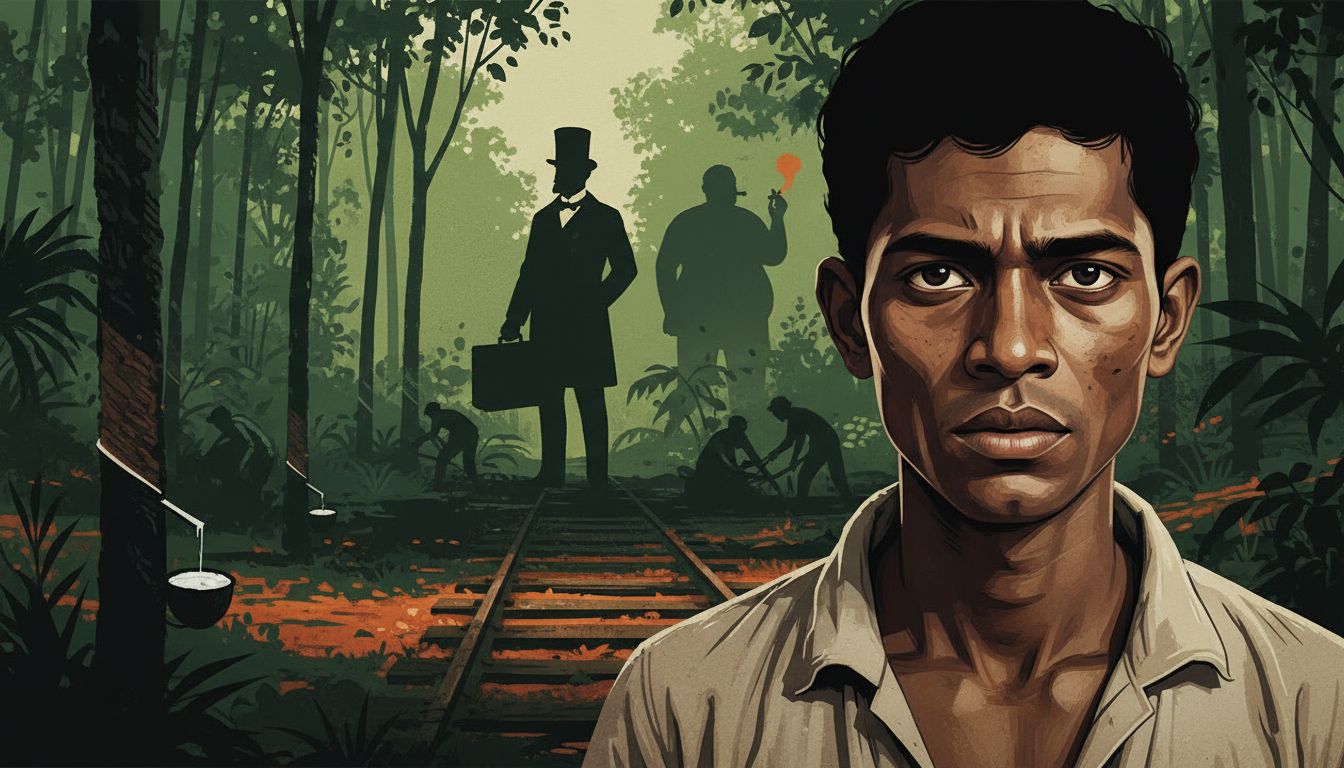
Malaya: The Cartel That Killed Three Continents
From biopiracy to the Death Railway: how a British rubber cartel stole seeds from Brazil, enslaved Tamil workers in Malaya, and orchestrated one of history's deadliest corporate conspiracies—with Winston Churchill at the helm.
Act 1
Cold Open: The Screams
Nadaraja Narasimulu remembered hearing the screams of those deemed too sick to live being buried alive. He was eighteen years old. He’d been forced to work on the Death Railway in Kanchanaburi, Thailand, in nineteen forty-three. One hundred twenty workers from his rubber processing factory in Malaya had been loaded onto trains. They’d been promised free train rides, healthcare, housing, and a daily salary of one Straits dollar—nearly four times what the British had paid them. Forty-one percent of them would die there. Thirty thousand to sixty thousand Malayans dead on the Death Railway. But here’s what you need to understand about those screams.
They weren’t just the sound of Japanese brutality during World War Two. They were the sound of a system that had been killing for seventy years before the first bomb fell on Pearl Harbor. Between eighteen eighty-six and nineteen fifty-seven, approximately seven hundred fifty thousand Tamil workers died during migration to Malayan rubber plantations. That’s one death every four hours. For seventy years. Straight. Estate mortality rates during the rubber boom ran at thirty per thousand annually. That’s three percent dying every year.
For comparison, Britain’s civilian death rate in World War One was less than one percent. And it all started with seventy thousand seeds stolen from Brazil in June eighteen seventy-six. A British adventurer named Henry Wickham smuggled them to Kew Gardens in London by falsely declaring them “exceedingly delicate botanical specimens specially designated for delivery to Her Britannic Majesty’s own Royal Gardens. ” Brazil banned rubber seed export. Wickham knew this. He lied anyway. Those seeds gave Britain control of seventy-five percent of global rubber supply by World War One. They ended Congo’s Red Rubber system—not through humanitarian pressure, but through economic competition that made plantation rubber cheaper than Leopold’s wild rubber extracted through mutilation.
They drove Henry Ford to build Fordlandia in the Amazon through Winston Churchill’s price manipulation scheme called the Stevenson Plan. They prompted Japan’s conquest of Southeast Asia. Malaya was, as one British lord put it, “the greatest material prize in South-East Asia. ” And they sparked Britain’s forgotten war in the nineteen fifties—called an Emergency so Lloyd’s of London insurance companies would pay claims. A war fought explicitly, as a Foreign Office secret file admitted, “in defence of the rubber industry. ” This is the story of the British rubber monopoly in Malaya. One act of biopiracy that connected three continents through systematic exploitation. Different methods.
Same commodity. Same consumers. Author Joe Jackson wrote that long before OPEC, Wickham’s seed theft “gave England the first global monopoly of a strategic resource in the history of humankind.
The Disagreeable Little Man
Henry Alexander Wickham was born in Hampstead, London, on May twenty-ninth, eighteen forty-six. He would spend most of his adult life in tropical America—Nicaragua, Honduras, and finally Brazil—trying and failing at various ventures. He attempted to grow sugar, tobacco, coconuts, bananas, and cacao. All failed. He tried exporting exotic bird feathers to London. Failed. By eighteen seventy-six, he was thirty years old, chronically broke, and living near Santarém on the Tapajós River in the Brazilian Amazon. But Wickham had been reading the newspapers.
He knew that Charles Goodyear’s vulcanization patent from eighteen forty-four had enabled rubber commercialization. He knew that John Boyd Dunlop would soon patent the inflatable bicycle tire in eighteen eighty-seven. He knew rubber demand was exploding. And he knew something else. In eighteen seventy-six, the British government was quietly offering payment for anyone who could deliver viable Hevea brasiliensis seeds to Kew Gardens. Ten pounds per thousand viable seeds. On June fifteenth, eighteen seventy-six, Wickham arrived at Kew with seventy thousand seeds packed in woven baskets. Brazilian customs officials had questioned him about the shipment.
Wickham presented papers declaring the cargo as “exceedingly delicate botanical specimens specially designated for delivery to Her Britannic Majesty’s own Royal Gardens at Kew. ” The customs officials, apparently impressed by the official language and royal designation, allowed the shipment through. Of the seventy thousand seeds, only two thousand seven hundred germinated. Less than four percent. Wickham received seven hundred pounds. In today’s money, approximately one hundred twenty thousand dollars. Not a fortune. But for a failed planter, it was something.
Kew Gardens immediately began propagating the seedlings. In eighteen seventy-six and eighteen seventy-seven, they shipped batches to Ceylon—modern-day Sri Lanka—and to Singapore. By eighteen seventy-seven, the first rubber plants had reached Malaya via the Singapore Botanical Gardens. H. N. Ridley became Director of the Singapore Botanical Garden in eighteen eighty-three. He championed rubber cultivation so aggressively that planters called him “Mad Ridley” or “Rubber Ridley. ” He’d walk estate to estate, literally giving away rubber seedlings and teaching planters how to tap trees without killing them.
By eighteen ninety-five, commercial rubber planting had begun in the Malay States. By eighteen ninety-seven, three hundred forty-five acres were under cultivation. By nineteen hundred one, fifteen thousand acres planted across British Asia. By nineteen ten, five hundred forty-two thousand acres. In nineteen thirteen—thirty-seven years after Wickham’s seed theft—cultivated rubber overtook wild rubber globally for the first time. Plantation rubber accounted for fifty-nine point three percent of world production. Congo’s share had dropped to two percent. On June third, nineteen twenty, King George the Fifth knighted Henry Wickham for his services to the rubber industry.
Queen Victoria had reportedly considered him “a disagreeable little man. ” Sir Joseph Hooker, Director of Kew Gardens, had refused to let him help establish the Asian plantations. Wickham spent his final years poor, living at the Royal Colonial Club. He died on September twenty-seventh, nineteen twenty-eight. In Brazil, he’s called “the father of bio-piracy” and “the prince of thieves. ” In Malaysia, there are monuments to him. But the question nobody asked Wickham—nobody asked Ridley, nobody asked the planters, nobody asked the British government—was simple. Who would actually do the work?
Ramasamy
In eighteen seventy-four—two years before Wickham’s seed theft—investigators arrived at the Malakoff estate in Province Wellesley. They’d received reports that one hundred workers had fallen sick. What they found were dirty, dilapidated huts permeated with filth and a putrescent stink. An old man named Ramasamy was found beaten to death. The estate owner, J. M. Vermont, wanted to make flogging legal. He argued it was necessary for maintaining discipline.
Vermont owned forty-five hundred acres. This was before the rubber boom. Most estates at this point still grew sugar, coffee, or pepper. But the labor system that would power rubber was already taking shape. In eighteen eighty-four, the Indian Immigration Ordinance formally established the framework for recruiting workers from South India. Male workers earned twelve cents per day. Female workers earned eight cents. By nineteen zero seven, as the rubber boom accelerated, the Tamil Immigration Fund Ordinance established the Indian Immigration Committee.
By nineteen ten, formal indenture—where workers were legally bound to estates—was officially replaced by something called the kangani system. Here’s how it worked. A kangani was a labor recruiter. Usually a Tamil who’d already worked on Malayan estates. He’d return to South India—typically to his home village or region—and recruit workers. The kangani received payment for each recruit he brought. He also received ongoing commissions based on their productivity once they started working. This created an incentive structure where kanganis prioritized quantity over honesty.
A colonial judge named J. Beaumont called the kangani system “a monstrous rotten system, rooted upon slavery, grown in its worst abuses and only the more dangerous because it presented itself under false colours. ” Historian Amarjit Kaur documented that kanganis “indulged in coercion. ” They kidnapped minors and caught recruits at weekly markets. They seduced young men with promises of getting them married in the colony. They misrepresented the nature of work and the rates of wages on the estates. One Tamil mother, interviewed in nineteen eighty-three, recalled: “Many were picked up from the roadside in Madras and put on boats to come here. ” A colonial report documented: “There is a regularly organised system in this district of kidnapping men and children and taking them down to coolie godowns in Negapatam, to be shipped from there to Pinang and other places which are thus regularly supplied with men as coolies and girls as prostitutes.
” Men as coolies. Girls as prostitutes. This wasn’t a side effect. It was part of the system. Once workers arrived in Malaya, estate mortality rates during the rubber boom years ran at thirty per thousand. Three percent dying every year. For context, Britain’s civilian death rate during World War One was less than one percent. Working on a Malayan rubber estate was three times deadlier than being a British civilian during the Great War.
Between eighteen eighty-six and nineteen fifty-seven, approximately seven hundred fifty thousand Tamil workers died during migration and on estates. Some scholars dispute this figure’s methodology. The number includes deaths during ocean voyages, deaths from disease shortly after arrival, and deaths on estates. But even conservative estimates acknowledge hundreds of thousands of deaths. Each one was someone’s child. Each one had a name. We know one of them. Ramasamy.
Beaten to death on the Malakoff estate in eighteen seventy-four because someone needed to maintain discipline.
Half a Cent Per Year
In eighteen eighty-four, male Tamil workers on rubber estates earned twelve cents per day. Female workers earned eight cents. By nineteen twenty-three, male wages had risen to forty cents. Female wages had reached thirty cents. That sounds like progress. Until you do the math. Thirty-nine years. Twenty-eight cents of wage growth for men.
That’s an increase of point seven two cents per year. But wait. By nineteen forty-one—fifty-seven years after eighteen eighty-four—male wages had only reached fifty cents. Thirty-eight cents of total growth over fifty-seven years. That’s point six seven cents per year. Less than one cent of annual wage increase. For nearly six decades. The British newspaper The Observer visited estates in the nineteen thirties and wrote: “Several times I have been shown with pride coolie lines on plantations that a kennelman in England would not tolerate for his hounds.
” Shown with pride. One employer, when questioned about low wages, stated that “Indians would work less and become lazy if they were paid more as they were essentially a satisfied lot and were better off here than in India. ” Meanwhile, Chinese tappers on the same estates were paid fifty to one hundred percent more than Tamil workers for identical work. Fifty to one hundred percent more. For the exact same job. In nineteen twelve, the Federated Malay States Labour Code mandated that estates provide accommodation for workers. By nineteen twenty-three, the code provided for estate schools and nurseries. On paper, the system was becoming more humane.
On paper. A nineteen thirty-six report by V. Srinivasa Sastri—a one-man committee investigating Indian worker conditions—documented systematic abuses. In nineteen thirty-eight, the Government of India banned all assisted emigration to Malaya. Not because Britain ended the kangani system. Because India stopped supplying workers. K. A.
Neelakanda Ayer, writing in nineteen thirty-eight, predicted that Indians in Malaya would become “tragic orphans—of whom India has forgotten and Malaya looks down upon with contempt. ” But by nineteen thirty-eight, the rubber industry had other problems. The Great Depression had devastated global prices. Between nineteen twenty-nine and nineteen thirty-two, Malayan rubber exports fell seventy-three percent. Prices crashed to one one-hundredth of the nineteen ten peak. Tan Kah Kee—called “the Henry Ford of Malaya”—saw his empire collapse in nineteen thirty-four. At his peak, he’d controlled fifteen thousand acres, thirty factories, one hundred fifty retail outlets, and thirty thousand employees. His net worth had exceeded twelve million yuan.
He’d founded Xiamen University in nineteen twenty-one. All gone. But before the Depression, before the collapse, before everything fell apart, there was a moment when the British rubber monopoly seemed unshakeable. A moment when Winston Churchill thought Britain could use that monopoly to make America pay.
Act 2
Churchill’s Cartel
By nineteen nineteen, Malaya’s rubber exports exceeded the rest of the world combined. Britain controlled seventy-five percent of global rubber supply. During World War One, the British naval blockade had cut Germany’s rubber supply entirely. After the war, prices collapsed. By nineteen twenty to twenty-one, rubber had fallen to nine pence per pound. On February nineteenth twenty-one, Winston Churchill became Secretary of State for the Colonies. The British Rubber Growers Association immediately petitioned him for market intervention. Churchill’s response was telling.
He said: “One of the principal means of paying our debt to the United States is in the provision of rubber. ” Britain owed America money from the war. America needed rubber. Churchill saw an opportunity. He appointed Sir James Stevenson to chair a Rubber Investigation Committee. Stevenson was the joint managing director of Johnnie Walker whisky. He’d created the slogan “Born in eighteen twenty—still going strong. ” Now he was tasked with designing a commodity cartel.
Something that would not, ironically, remain strong. On October nineteenth twenty-two, the Federal Legislative Council of Malaya passed the Export of Rubber Restriction Enactment. On November first, nineteen twenty-two, the Stevenson Plan was officially enacted. Here’s how it worked. Britain would restrict rubber exports from Malaya and Ceylon based on historical production quotas. If you’d produced a certain amount in the base years—nineteen nineteen and nineteen twenty—you could export that amount plus or minus adjustments based on current prices. When prices were low, export quotas would be reduced to restrict supply. When prices were high, quotas would be increased.
The goal was simple: artificially manipulate global supply to keep prices elevated. It worked. Brilliantly. For a while. In nineteen twenty-two, rubber sold for about seventeen cents per pound. By nineteen twenty-five, prices had peaked at one dollar twenty-one cents per pound. That was a seven hundred twelve percent increase in three years. Herbert Hoover, U.
S. Secretary of Commerce, was furious. He declared that the Stevenson Plan “threatened the American way of life. ” The Rubber Association of America calculated that “as a result of the operation of the scheme, the price of rubber has been forced up to about three times the normal price of thirty-six cents. ” American automobile production was exploding. Henry Ford’s Model T was selling millions. Every single car needed rubber tires. And Britain controlled the supply.
American industrialists faced a choice. Pay Britain’s inflated prices and watch profits evaporate. Or find rubber elsewhere. In the summer of nineteen twenty-five, Henry Ford sat down to lunch with Harvey Firestone in Dearborn, Michigan. Two of America’s most powerful industrialists discussed their options. Firestone would secure a ninety-nine year lease for one million acres in Liberia. Six cents per acre. Ford would secure two point five million acres in the Brazilian Amazon.
Both men believed they could break Britain’s monopoly. Both would be wrong. But not for the reasons they thought. The Stevenson Plan had one critical flaw. The Dutch East Indies refused to participate. Dutch planters in Sumatra and Java watched British Malaya artificially restrict its own production. And they simply increased theirs. Dutch exports surged.
They captured market share. They built new capacity. By nineteen twenty-seven, prices had collapsed back to six pence per pound. Sir James Stevenson—the man who designed the scheme—died on June tenth, nineteen twenty-six, aged fifty-three. Churchill wrote a tribute: “During his ten years of public service for honour alone Lord Stevenson wore out the whole of his exceptional strength of mind and body. ” On November first, nineteen twenty-eight, the Stevenson Plan was officially repealed. Exactly six years after it began. It had achieved nothing except strengthening Dutch competitors and prompting American industrialists to pursue disastrous independent rubber ventures in Africa and South America.
But here’s the darkly comic part. In December nineteen twenty-eight—one month after the Stevenson Plan’s repeal—Henry Ford’s ships arrived at the Fordlandia site in Brazil. The economic rationale for the project had evaporated. Ford persisted anyway. For seventeen more years. In nineteen forty-five, he’d sell Fordlandia and Belterra back to Brazil at a massive loss. As NPR later reported: “Not one drop of latex from Fordlândia ever made it into a Ford car. ” Greg Grandin, Ford’s biographer, wrote: “Ford’s great delusion was not that the Amazon could be tamed but that the forces of capitalism, once released, might yet be contained.
” The same delusion applied to Churchill’s rubber cartel. Britain believed it could control global markets through colonial power. The Dutch proved them wrong. And someone else was watching Malaya’s rubber supplies with great interest.
Tory Eden
The nineteen thirties in Malaya were called “Tory Eden” by British capitalists. One historian wrote that “the enterprise was so lucrative that one writer even labelled Malaya in the nineteen thirties as a ‘Tory Eden. ’” Then he added: “The Japanese invasion in World War Two destroyed this hubris forever. ” But before the destruction, there was prosperity. For some. By nineteen twenty-two, two point two six million acres were under rubber cultivation in Malaya. Sixty percent European ownership. Forty percent Asian.
Chinese entrepreneurs had become major players. Tan Chay Yan—who died in nineteen sixteen—had created Asia’s first rubber plantation in eighteen ninety-six. In nineteen hundred, he received a trophy for being “the first man in world to produce commercial sheet rubber. ” Chung Keng Quee, the “Kapitan China,” controlled the Penang-based Hai San Secret Society and the Larut tin-fields. He had over fifteen thousand coolies under his control. In eighteen eighty-seven, he was the largest tin producer in Perak—twenty-nine thousand pikuls out of two hundred twenty thousand for the entire state. He donated one hundred thousand taels to the Qing Government for the Sino-French War. He built the Penang Peranakan Mansion on the former Ghee Hin headquarters.
But the biggest was Tan Kah Kee. Born in eighteen seventy-four in Jimei, Fujian Province, Tan arrived in Singapore as a teenager. By his peak, he controlled fifteen thousand acres of rubber plantations. Thirty factories. One hundred fifty retail outlets. Thirty thousand employees. His net worth exceeded twelve million yuan. In nineteen twenty-one, he founded Xiamen University with two million yuan of his own money.
He believed in education, in modernization, in the Chinese diaspora contributing to China’s development. Then the Great Depression hit. Between nineteen twenty-nine and nineteen thirty-two, Malayan rubber exports fell seventy-three percent. Rubber prices crashed to one one-hundredth of the nineteen ten peak. By nineteen thirty-two, male workers were earning twenty to twenty-five cents per day. Less than they’d earned in nineteen twenty-three. Wages had gone backward. Tan Kah Kee’s business empire collapsed in nineteen thirty-four.
He lost everything except his commitment to Xiamen University, which he continued supporting until the Japanese invasion of China forced him into even greater financial distress. In June nineteen thirty-four, Britain signed the International Rubber Regulation Agreement with the Dutch and French. Another cartel. Another attempt to control global markets. This one would last longer than the Stevenson Plan. But it wouldn’t survive the war. Because by the late nineteen thirties, someone else was looking at Malaya’s rubber supplies. Someone who needed rubber for a war machine.
Someone who’d been cut off from Western supplies by embargoes. Japan.
Act 3
The Greatest Material Prize
In nineteen forty-two, a Canadian rubber regulator named Alan H. Williamson wrote that “rubber alone constitutes one of the gravest and most ominous problems in our history. ” His colleague J. R. Nicholson was more direct. “The loss of plantations in the Far East,” he wrote, “has placed the whole Allied war program in jeopardy. ” Japan invaded Malaya on December eighth, nineteen forty-one. Landing at Kota Bharu.
Two days later, Japanese aircraft sank HMS Prince of Wales and HMS Repulse. On February fifteenth, nineteen forty-two, Singapore fell. Eighty-five thousand Allied troops surrendered. Winston Churchill—the same Churchill who’d launched the Stevenson Plan twenty years earlier—called it “the worst disaster and largest capitulation in British history. ” One British lord would later describe Malaya as “the greatest material prize in South-East Asia. ” Another said: “What we should do without Malaya, and its earnings in tin and rubber, I do not know. ” The Colonial Secretary Arthur Creech-Jones admitted in nineteen forty-eight: “It would gravely worsen the whole dollar balance of the Sterling Area if there were serious interference with Malayan exports. ” The war wasn’t just about ideology.
It was about rubber. Between February eighteenth and March fourth, nineteen forty-two, Japanese forces conducted what became known as the Sook Ching massacre. Sook Ching means “purge through cleansing. ” General Tomoyuki Yamashita, called the Tiger of Malaya, commanded the conquest. But the order for Sook Ching came from Colonel Masanobu Tsuji, chief of planning and operations for the Twenty-Fifth Army. Chinese men aged eighteen to fifty were ordered to report for screening. Those suspected of anti-Japanese sentiment—which could mean almost anything—were taken away. The official Japanese count is five thousand to six thousand deaths.
Lee Kuan Yew, who lived through the occupation, estimated seventy thousand. Historians generally accept twenty-five thousand to fifty thousand as more likely. Japan has never conducted a formal investigation. Major Hayashi Tadahiko later told a correspondent that half of the planned fifty thousand Chinese had been killed before orders came to stop. Half of fifty thousand. Twenty-five thousand. Before they stopped. Chia Chew Soo’s father, uncles, aunts, brothers and sisters were bayoneted one by one by Japanese soldiers in Simpang Village.
Ethelin Teo was thirteen years old during the war. She dressed as a boy to avoid being abducted as a comfort woman. She remembers seeing thieves hung from trees by Japanese soldiers in Kuantan. Five bodies. Five trees. Colonel Tsuji—the man who ordered the killing of fifty thousand Chinese, twenty percent of Singapore’s Chinese population—escaped war crimes trials. He became a Japanese politician. He disappeared in Laos in nineteen sixty-one.
General Yamashita was executed in the Philippines in nineteen forty-six. But Tsuji lived free for sixteen more years. Lee Kuan Yew later wrote that the Japanese “showed a meanness and viciousness towards their enemies equal to the Huns. ” “Genghis Khan and his hordes could not have been more merciless,” he continued. “I have no doubts about whether the two atom bombs were necessary. ” But Sook Ching wasn’t the only Japanese atrocity in Malaya. There was also the Death Railway.
The Death Railway
In nineteen forty-three, seventy-eight thousand two hundred four Malayans were forced to work on the Burma Railway. Forty-one percent of them died. Thirty thousand to sixty thousand deaths. The Japanese had promised free train rides, healthcare, housing, and a daily salary of one Straits dollar. Compared to the fifteen to twenty-five cents the British had been paying during the Depression, this sounded generous. M. Ponnusamy was working at Ladang Cashwood when Japanese agents came recruiting. They called it “volunteering.
” At Taiping train station, Ponnusamy realized what he’d actually signed up for. Four hundred to five hundred romusha—forced laborers—were crammed into cattle cars. On the train, he met another man also named Ponnusamy. This man had been forced to leave his young wife and aging mother behind. The most unforgettable experience, M. Ponnusamy later recalled, was having to sleep with a corpse because he was too exhausted to move. Sometimes the corpse was headless. Sometimes he used the corpse as a pillow.
The other Ponnusamy died from starvation, torture, and exhaustion. Before dying, he asked M. Ponnusamy to care for his family. After the war, M. Ponnusamy escaped by following the train tracks home. He married his friend’s widow. He took care of her mother. He kept his promise.
K. N. Sellapah was twenty-seven when recruited as a field conductor at Ladang Bikam. He went with his friends. When he returned to Malaysia in nineteen forty-five, only forty-seven of his friends had survived. Until his death, Sellapah was disappointed that neither Japan nor Britain compensated the romusha families. Neither Japan nor Britain. Both had exploited them.
Neither paid. Dr. Robert Hardie, a British POW and plantation manager, wrote about what he witnessed. “A lot of Tamil, Chinese, and Malay labourers from Malaya have been brought up forcibly to work on the railway,” he documented. “They were told that they were going to Alor Star in northern Malaya; that conditions would be good—light work, good food and good quarters. ” “Once on the train, however, they were kept under guard and brought right up to Siam. ” “The wretched natives,” Hardie continued, lived with “corpses rotting unburied in the jungle, almost complete lack of sanitation, frightful stench, overcrowding, swarms of flies. ” Mooniady Ramasamy recalled the moment he was taken.
“The soldiers forced me to get into the lorry. ” “I was wearing only a pair of shorts and sandals. ” “The Japanese soldiers did not allow me to go home; instead they sent me directly to Kuala Lumpur and loaded me onto a freight train for Siam. ” “There we started cutting dense jungle. ” “I had to work in the jungle and sleep on the bamboo floor in a hut, half naked and without any blanket. ” Nadaraja Narasimulu—the eighteen-year-old we met at the beginning—remembered hearing the screams. Those deemed too sick to live. Buried alive.
By October nineteen forty-three, the Burma Railway was completed. Two hundred fifty-eight miles. Ninety thousand civilian deaths. Twelve thousand Allied POW deaths. Patricia Lariche remembers hiding in toilets to escape being raped by Japanese soldiers. Her father was working as chief clerk of Cheriot Estate but was taken away to the railway. Sybil Kathigasu, the only Malayan woman awarded the George Medal, provided medical care and radio information to MPAJA guerrillas during the occupation. She was arrested in August nineteen forty-three.
Tortured by the Kempeitai—Japanese military police. Her seven-year-old daughter Dawn was threatened with burning to extract information from Sybil. Sybil refused to talk. She was sentenced to life imprisonment. She survived. She wrote her memoir “No Dram of Mercy. ” Her torturer, Sergeant Yoshimura Ekio, was executed at Taiping Prison on May twenty-fourth, nineteen forty-six. In August nineteen forty-five, Japan surrendered.
The MPAJA—Malayan Peoples Anti-Japanese Army—briefly controlled parts of Malaya. Many of them were communists. Many had fought alongside British officers during the war. Britain had armed them, trained them, worked with them. Three years later, Britain would be hunting them through the jungle.
Twenty-Seven Strikes Per Week
Between nineteen forty-five and nineteen forty-six, labor unrest swept through Malaya like a fever. Twenty-seven strikes per week. For seven consecutive weeks. Seven hundred thirteen thousand worker days lost. On January twenty-ninth, nineteen forty-six, one hundred fifty thousand to two hundred thousand workers struck in Singapore. By April nineteen forty-seven, the Pan Malayan Federation of Trade Unions had reached two hundred sixty-three thousand five hundred ninety-eight members. Workers were demanding an end to abuse by non-European staff. An end to molestation of their women by European and non-European staff.
Basic human dignity. As one historical account put it: “Tamil trade unionists refused to suffer any longer the use of the derogatory term ‘Kling. ’” “Estate workers no longer dismounted from their bicycles when a dorai—a planter—passed by. ” These weren’t revolutionary demands. They were asking not to be insulted. Not to dismount their bicycles like servants. And the British treated it as a crisis. On March nineteen forty-seven, police shot and killed one worker at Dublin Estate.
Five others were wounded. Tensions escalated. On June sixteenth, nineteen forty-eight, at eight thirty in the morning, A. E. Walker was shot at his office desk. He was the manager of Elphil Estate in Sungai Siput, Perak. Two Chinese men arrived on bicycles. They said “good morning.
” Then they fired. Walker’s friends called him “Wally. ” He’d been one of the original “gardeners” in Japanese prison camps—prisoners who risked their lives growing food for fellow POWs. His obituary described him as “always ready and willing to help a pal not so gifted in the art of existing. ” That same day, John Allison, aged fifty-five, manager of Phin Soon Estate, was shot. His hands were tied. His automatic pistol had been seized. He was executed in cold blood.
Ian Christian, a young assistant manager, was tied up and shot alongside him. The next day—June seventeenth, nineteen forty-eight—Britain declared an Emergency in Malaya. Not a war. An Emergency. And this is where it gets darkly absurd.
Act 4
The Insurance Emergency
Former British soldier Len Barrett later explained why it was called an Emergency. The Malayan Planters Association “did not wish the war to be referred to as such owing to their lack of war risk liabilities insurance cover. ” Lloyd’s of London wouldn’t pay claims if it was officially a war. So it was an Emergency. Foreign Minister Robert Scott confirmed this in nineteen fifty. “The decision to call the insurgents ‘bandits’ or ‘terrorists’ was taken originally because of the insurance implications of the words ‘insurgents’ or ‘rebels’ or ‘enemy. ’” J. D.
Higham of the Colonial Office was even more explicit. “On no account should the term ‘insurgent’, which might suggest a genuine popular uprising, be used. ” Couldn’t suggest a genuine popular uprising. Even though that’s exactly what it was. A Foreign Office secret file, later declassified, stated the truth plainly. “In its narrower context, the war against bandits is very much a war in defence of the rubber industry. ” In defence of the rubber industry. Not defending democracy.
Not fighting communism. Defending rubber profits. One British lord said it in the House of Lords in nineteen fifty-two: “What we should do without Malaya, and its earnings in tin and rubber, I do not know. ” Another called Malaya “the greatest material prize in South-East Asia. ” By nineteen forty-nine, ten thousand suspected communist sympathizers had been deported to China. Ten thousand. Without trials. Without appeals.
Just deported. In April nineteen fifty, Sir Harold Briggs was appointed Director of Operations. He looked at the problem—Chinese squatters living on the jungle’s edge, potentially supplying food to MNLA guerrillas—and came up with a solution. Forced resettlement. Mass internment. Concentration camps with a prettier name.
The Briggs Plan
In May nineteen fifty, the Briggs Plan was issued. Five hundred thousand to five hundred seventy-three thousand Chinese squatters would be forcibly resettled into “New Villages. ” Historian Brian Lapping described the process. “A community of squatters would be surrounded in their huts at dawn, when they were all asleep, forced into lorries and settled in a new village encircled by barbed wire with searchlights round the periphery to prevent movement at night. ” Surrounded at dawn. Forced into lorries. Barbed wire. Searchlights.
Chin Peng, secretary-general of the Malayan Communist Party, later recalled what happened if people refused. “They forced you to go, and they burned all your house. ” “And then if you want to resist, you stay in the house they don’t care, they would burn you. ” “Some people stayed in the house, they did not want to move. ” “If you don’t move, then maybe you have to be burned—to be burned alive. ” Burned alive if you refused to move. This was British policy in nineteen fifty. A Hakka song from Tras New Village captured the experience.
“The bamboo music was lively and rousing. ” “How miserable Tras resettlement was. ” “Here another meal with dried and salted fish. ” “A deeply bitter experience we suffer in silence. ” Historian John Newsinger wrote that people in New Villages were “effectively deprived of all civil rights. ” But it wasn’t just Chinese squatters who suffered. Up to seven thousand Orang Asli—indigenous peoples—died during resettlement operations. This figure comes from a former director-general of the Department of Aboriginal Affairs.
Seven thousand. The original inhabitants of Malaya. Dead in camps. The Aboriginal Peoples Ordinance was enacted in nineteen fifty-four—after the deaths—supposedly to protect them. On October sixth, nineteen fifty-one, Sir Henry Gurney, High Commissioner for Malaya, was assassinated at Mile fifty-six and a half of the Kuala Kubu Road. His convoy was ambushed. When bullets started hitting his car, Gurney pushed his wife into the footwell. Then he exited the vehicle and walked toward his ambushers to draw their fire away from her.
He died on the road. His epitaph reads: “Greater love hath no man than this. ” Chin Peng later confirmed that the guerrillas hadn’t known Gurney was in the convoy. They’d been targeting a different vehicle. He died by accident. In January nineteen fifty-two, Britain appointed someone new. Sir Gerald Templer. High Commissioner and Director of Operations.
Combined civil and military authority. And Templer had a phrase that would become famous.
Hearts and Minds
Sir Gerald Templer is famous for saying: “The answer lies not in pouring more soldiers into the jungle, but in the hearts and minds of the Malayan people. ” Hearts and minds. This is where that phrase comes from. Not from Vietnam. From Malaya. It would be used in Vietnam. In Iraq. In Afghanistan.
Every counterinsurgency since has repeated Templer’s words like a mantra. But here’s what Templer actually did while winning hearts and minds. He ordered twenty-two hour curfews for entire villages suspected of aiding guerrillas. Twenty-two hours. Two hours per day to live. He reduced rice rations for twenty thousand civilians. Collective punishment. Starve the civilians, and maybe they’ll stop feeding the guerrillas.
The London School of Hygiene warned: “This measure is bound to result in an increase, not only of sickness but also of deaths, particularly amongst the mothers and very young children. ” Templer proceeded anyway. In April nineteen fifty-two, photographs were published. British soldiers posing with severed heads. Templer had approved the use of Dayak headhunters from Borneo. British officers led them. They tracked guerrillas through the jungle and brought back heads as trophies. A Colonial Office internal note later admitted: “There is no doubt that under international law a similar case in wartime would be a war crime.
” Would be a war crime. But they called it an Emergency. So apparently it didn’t count. In the summer of nineteen fifty-two, Britain began spraying herbicides from aircraft. Two, four, five-T. The same chemical that would later be used as Agent Orange in Vietnam. The goal was to destroy jungle cover and food crops that might feed guerrillas. The reality was poisoning the land and everyone on it.
Templer also said: “I’ll shoot the bastard who says that this emergency is over. ” And: “The hard core of armed communists in this country are fanatics and must be, and will be, exterminated. ” Exterminated. That was the word he used. On December twelfth, nineteen forty-eight—before Templer’s appointment but part of the same Emergency—the Batang Kali massacre occurred. Scots Guards killed twenty-four unarmed Chinese civilians. The official story was that the men were shot while escaping. Evidence suggests they were lined up and executed.
The village was burned. In twenty fifteen—sixty-seven years later—the UK Supreme Court ruled that no public inquiry was required. Too much time had passed. Four years into the Emergency, the Colonial Office quietly noted something interesting. “No operational links have been established as existing” between the MNLA and Soviet or Chinese communists. No operational links. Four years into a war supposedly about stopping communist expansion. And there were no operational links to communist powers.
Chin Peng would later say: “Colonial exploitation, irrespective of who were the masters, Japanese or British, was morally wrong.
Independence and Aftermath
On December twenty-eighth and twenty-ninth, nineteen fifty-five, peace talks were held in Baling. Chin Peng met with Tunku Abdul Rahman, who would become Malaya’s first Prime Minister. The talks failed. On August thirty-first, nineteen fifty-seven, Malaya gained independence from Britain. But here’s the thing. British companies retained control of tin mines and rubber plantations. Political independence. Economic colonialism.
The Emergency officially ended on July thirty-first, nineteen sixty. Twelve years. Six thousand seven hundred ten to six thousand seven hundred eighty-one MNLA guerrillas killed, depending on the source. Five hundred to one thousand four hundred forty-two British military deaths. Civilian deaths remain poorly documented. Nobody counted carefully. Chin Peng had been awarded the OBE by Britain for his anti-Japanese resistance during World War Two. The British gave him a medal.
Then they hunted him for sixty years. The award was withdrawn. On December second, nineteen eighty-nine, Chin Peng signed the Hat Yai Peace Agreement. The fighting finally stopped. Fourty-one years after it began. Malaysia banned him from returning to the country. He died in exile in Bangkok on September sixteenth, twenty thirteen. Ninety-nine years old.
Never allowed home. Sir Harold Briggs—architect of the New Villages—died in nineteen fifty-two. His health destroyed by service. Henry Wickham died on September twenty-seventh, nineteen twenty-eight. He’d been knighted by King George the Fifth on June third, nineteen twenty, for services to the rubber industry. He spent his final years poor at the Royal Colonial Club. In Brazil, he’s called “the father of bio-piracy” and “prince of thieves. ” Today, six hundred thirteen New Villages remain across Malaysia.
The original Briggs Plan layouts are preserved. Barbed wire replaced with parks. Searchlights removed. They’re being considered for UNESCO World Heritage nomination. Concentration camps as heritage sites. The oldest rubber tree from eighteen ninety-five still stands near Kuala Kangsar Clock Tower. Descended from Wickham’s stolen seeds. Veloo Saminathan, a Malaysian historian, wrote about the Tamil workers.
“Despite the privations in a hostile environment, these labourers prevailed and laid the foundations of the rubber industry. ” “They remain unsung and buried in anonymity, many dying prematurely after earning a pittance for their back-breaking toil. ” C. Rajah traveled from India to British Malaya around nineteen twenty. He made his home at Foothills Estate, Kulim. His descendant wrote a photo essay about the family. It was, the descendant explained, “an attempt to counter the stereotype in modern Malaysia that those who come from the estates are to be regarded as ‘uncultured, illiterate and poor. ’” That’s what seventy years of exploitation bought.
A stereotype of poverty and ignorance.
The Throughline
Between eighteen seventy-six and nineteen sixty, one act of seed theft created a commodity empire that spanned three continents. It ended Congo’s Red Rubber. Not through moral pressure. Through economic competition that made plantation rubber cheaper than Leopold’s wild rubber extracted through mutilation and severed hands. Roger Casement’s Congo Reform Association closed operations in nineteen thirteen. The same year cultivated rubber overtook wild rubber globally. Mission accomplished. Not because the atrocities stopped.
Because they moved. It drove Henry Ford to his greatest failure. In the summer of nineteen twenty-five, Ford and Firestone met in Dearborn to discuss Churchill’s rubber cartel. Ford went to Brazil. Firestone went to Liberia. Both failed spectacularly. Not one drop of Fordlandia latex ever made it into a Ford car. It killed seven hundred fifty thousand Tamil workers during migration and on estates.
Some scholars dispute this number. Even conservative estimates acknowledge hundreds of thousands. We know one of their names. Ramasamy. Beaten to death at Malakoff estate in eighteen seventy-four. We know others. M. Ponnusamy, who slept with corpses on the Death Railway and kept his promise to marry his dead friend’s widow.
Nadaraja Narasimulu, who heard the screams of those buried alive because they were too sick to work. Wally Walker, shot at his desk on June sixteenth, nineteen forty-eight, by men who said “good morning” first. It prompted Japan’s conquest of Southeast Asia. Malaya was “the greatest material prize in South-East Asia. ” Between twenty-five thousand and seventy thousand Chinese died in the Sook Ching massacre. Thirty thousand to sixty thousand Malayans died on the Death Railway. And it sparked Britain’s forgotten war. Called an Emergency so Lloyd’s of London would pay insurance claims.
Fought explicitly, as the Foreign Office admitted, “in defence of the rubber industry. ” Winston Churchill played both ends of this story. As Colonial Secretary in nineteen twenty-two, he launched the Stevenson Plan to exploit American dependence on rubber. He said: “One of the principal means of paying our debt to the United States is in the provision of rubber. ” As Prime Minister in nineteen fifty-two, he appointed Gerald Templer to fight communists to preserve rubber profits. Templer coined “hearts and minds” while ordering twenty-two hour curfews, reducing rice rations for twenty thousand civilians, approving Dayak headhunters, and spraying herbicides that would later be banned as war crimes in Vietnam. Over fifty-seven years, wages for Tamil workers rose from twelve cents to fifty cents per day. That’s point six seven cents of annual increase.
Less than one cent per year. For nearly six decades. Each one was someone’s child. The British rubber monopoly in Malaya represents one of history’s most successful commodity cartels. It also represents one of history’s most devastating. Different methods across three continents. Congo’s mutilation. Amazon’s Putumayo genocide.
Malaya’s kangani system and Emergency internment. Same commodity. Same consumers. Same silence about the human cost. In Brazil, Henry Wickham is called “the prince of thieves. ” In Malaysia, there are monuments to him. In London, he died poor and forgotten at the Royal Colonial Club. In the New Villages of Malaysia, six hundred thirteen concentration camps have been converted into towns.
Barbed wire replaced with parks. Searchlights removed. Being considered for UNESCO World Heritage status. The oldest rubber tree still stands near Kuala Kangsar Clock Tower. Descended from seventy thousand stolen seeds. Of which only two thousand seven hundred germinated. But two thousand seven hundred was enough.