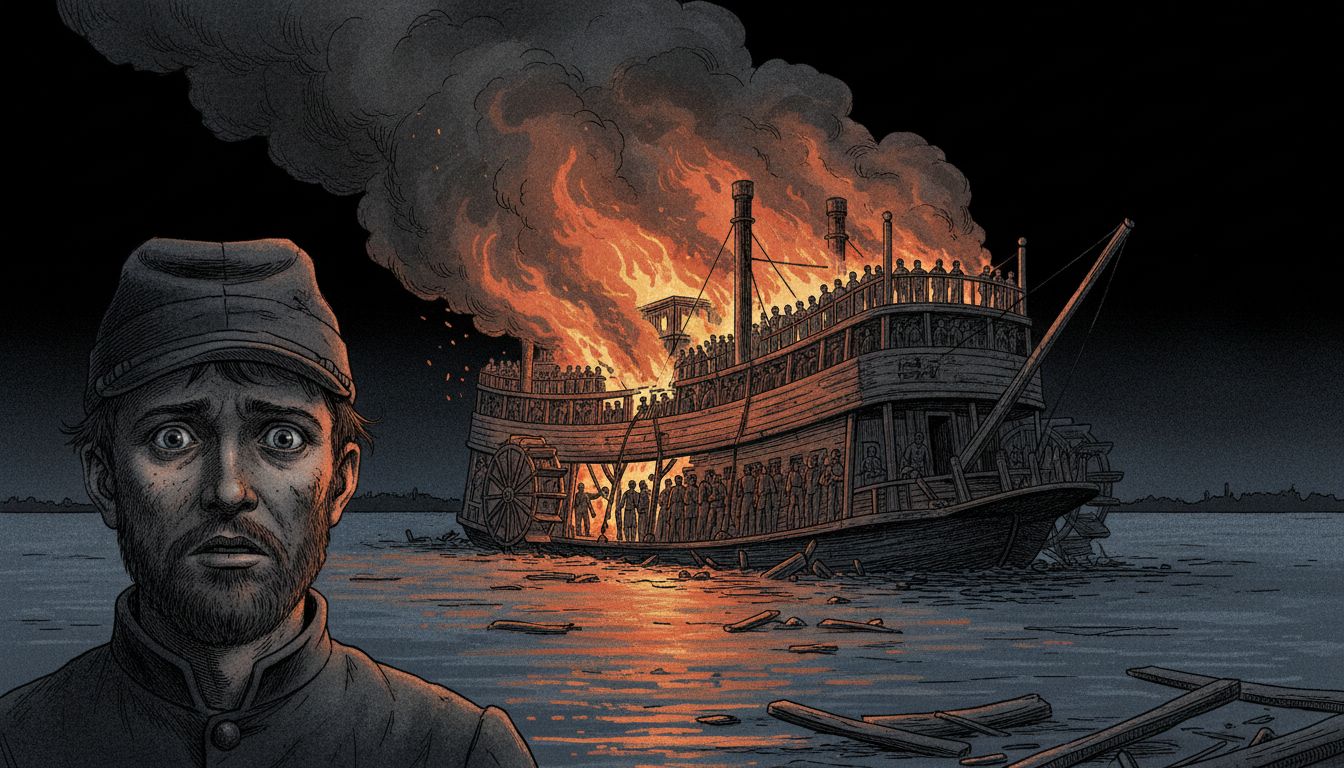
The Sultana: America's Forgotten Titanic
On April 27, 1865, the steamboat Sultana exploded on the Mississippi River, killing 1,864 people—more than the Titanic. Most victims were Union POWs who had just survived Andersonville and Cahaba prison camps. This is the story of the deadliest maritime disaster in American history, buried by history because it happened the same day John Wilkes Booth was killed.
Act 1
Cold Open
At two o’clock in the morning on April 27th, 1865, the children froze first. Most of them were teenage farm boys from Ohio and Indiana. They’d survived months in Confederate prison camps—Andersonville, Cahaba—where disease and starvation had been methodical and deliberate. They’d made it through hell. And now eighteen hundred of them were burning alive in the Mississippi River, in a disaster that would kill more Americans than the Titanic. This happened the day after John Wilkes Booth was killed. Every newspaper in the country had room for only one story. The tragedy that claimed eighteen hundred sixty-four lives went almost unnoticed.
More Americans died here than at Pearl Harbor. Almost no one remembers their names. The Sultana was designed to carry three hundred seventy-six passengers. That night, she carried over twenty-one hundred—Union soldiers finally going home. Most of them were barely twenty years old. Then, within sight of Memphis, three of the ship’s four boilers exploded. Men sleeping on the upper decks were blown three hundred feet into the air. This is the story of the Sultana.
The Prisons
To understand why the Sultana was so dangerously overcrowded, we need to go back three months. To the prison camps where these men had been held. Cahaba Prison, near Selma, Alabama. Built to hold a thousand men. By March of 1865, it held over three thousand. Picture that for a moment. Three times the intended capacity. In a prison designed for crowding to begin with.
One survivor described it simply. Quote: “We were packed like cattle in a pen. ” There was no room to lie down. Men slept standing up, leaning against each other. Imagine trying to sleep that way. Night after night. For months. In March of 1865, the Alabama River flooded.
The prison yard filled with water three feet deep. The Confederate guards told the prisoners to climb onto whatever they could find. Anything to stay above the water line. Fences. Scaffolding. Each other. Samuel Haines, Company K of the 65th Ohio, later wrote about that flood. He said they had to hunt for dry places to lie down.
The first night, he found one. The second night, he found one. After that, there were none left. So he slept in water. For weeks. Standing up or sitting down, it didn’t matter. The water was always there. Cold.
Filthy. Breeding disease. But if Cahaba was hell, Andersonville was something worse. Something beyond language. Andersonville Prison in Georgia opened in February 1864. It was designed as a temporary solution to overcrowding in other Confederate prisons. The prison was a sixteen-and-a-half-acre open stockade. No barracks.
No shelters. Just a fence and dirt. Prisoners built their own shelters from whatever they could scrounge. Scraps of wood. Bits of cloth. Mud. Thirty-three thousand Union prisoners were held there during the war. At its peak, in August 1864, it held over thirty-two thousand men.
In sixteen acres. That’s two thousand men per acre. Thirteen thousand of them died. That’s a forty percent mortality rate. Four out of every ten men who entered Andersonville never left. Let that number sink in. Forty percent. They died of starvation.
Dysentery. Scurvy. Gangrene. They died because the Confederate Army couldn’t feed itself, let alone feed prisoners. They died because there were no medical supplies, no shelter, no sanitation. There was one stream running through the camp. It served as the water supply, the sewer, and the morgue all at once. Men upstream would drink from it.
Men downstream would wash in it. And the dead would float through it. John Scott, a twenty-two-year-old from Wisconsin, survived Andersonville. He later wrote a book about his experience. He watched his tent-mate Viktor freeze to death one January night. By morning, the body was too stiff to move. Scott also watched men die from scurvy. Their gums would swell and their teeth would fall out.
Then they’d develop sores that wouldn’t heal. Then they’d die. He watched men die from dysentery, wasting away until they were nothing but skin and bone. He watched men die from gangrene after minor injuries became infected in the filth. And he watched men simply give up. Lie down. Stop eating. Stop moving.
And fade away. The guards had a name for these men. They called them “gone-ups. ” Men who had given up on life. But most of the men didn’t give up. They held on. They endured. They survived because they had something to live for.
Home. They dreamed of home. Talked about home. Planned what they’d do when they got home. And in April 1865, the war finally ended. Lee surrendered at Appomattox on April 9th. And suddenly, there were tens of thousands of Union prisoners who needed to go home. The men at Cahaba and Andersonville were marched to Vicksburg, Mississippi.
To a parole camp. There, they would wait for riverboats to take them north. Back to Ohio, Michigan, Indiana, Kentucky. Back to families who didn’t know if they were alive or dead. The march to Vicksburg was brutal. These were men who’d been starved for months. Weakened by disease. Barely able to walk.
But they walked anyway. Because at the end of the march was a boat. And at the end of the boat ride was home. They’d been promised they were going home. Finally, after months of suffering, they were going home. At the parole camp in Vicksburg, they rested. They ate real food for the first time in months. They bathed.
They slept lying down. They started to feel human again. And then they waited for the boats. But getting them home required boats. And boats meant money. And money, as always, meant opportunity for someone willing to bend the rules.
The Deal
The Sultana was a regular steamboat on the Mississippi River. Built in Cincinnati in January 1863, she ran between St. Louis and New Orleans. Two hundred and sixty feet long. Forty-two feet wide. Powered by four massive boilers that drove two side-mounted paddle wheels. Her captain was James Cass Mason of St. Louis.
He was forty-three years old. A career riverboat man. And in April of 1865, he was desperately in need of money. On April 13th, the Sultana left St. Louis, bound for New Orleans. Two days later, when she tied up at Cairo, Illinois, word reached the city that President Lincoln had been shot. Captain Mason grabbed an armload of newspapers and headed south. He knew the telegraph lines to the southern states had been cut during the war.
He could sell papers. Spread the news. Make a little money. When the Sultana reached Vicksburg, Mississippi, Captain Mason was approached by a man named Reuben Hatch. Captain Reuben Hatch was the chief quartermaster at Vicksburg. It was his job to coordinate the transport of paroled prisoners north. And Hatch had a proposition for Captain Mason. The U.
S. government would pay two dollars and seventy-five cents for every enlisted man transported north. Eight dollars for every officer. There were thousands of prisoners at the parole camp outside Vicksburg, waiting to go home. Hatch told Mason he could guarantee him a full load. About a thousand men. That would be over two thousand dollars. A fortune in 1865.
There was just one condition. Mason would have to give Hatch a kickback. This was bribery. Plain and simple. Reuben Hatch was using his position to enrich himself and Captain Mason at government expense. And this wasn’t the first time. Reuben Hatch had a long history of corruption. He’d been brought up on court-martial charges multiple times during the war for theft and fraud.
He’d bilked the government out of thousands of dollars. But Hatch had protection. His older brother, Ozias Hatch, was a close friend and advisor to President Lincoln. Whenever Reuben Hatch was charged with a crime, he would get letters of recommendation from President Lincoln himself. And from General Ulysses S. Grant. Those letters still exist in the National Archives in Washington. So when Reuben Hatch approached Captain Mason with his offer, Mason knew exactly who he was dealing with.
A corrupt officer with powerful friends. A man who could make problems disappear. Mason agreed to the deal. But there was a problem. One of the Sultana’s boilers had sprung a leak on the way upriver from New Orleans. Under reduced pressure, the steamboat had limped into Vicksburg. The boiler needed to be repaired before she could carry passengers. A mechanic was brought in to examine the damage.
He found a ruptured seam on one of the boiler plates. The proper repair, he said, would be to cut out the damaged section and replace it entirely. But that would take two or three days. Captain Mason couldn’t wait two or three days. By then, the prisoners would have been loaded onto other boats. His deal with Hatch would be worthless. So Mason and his chief engineer, Nathan Wintringer, convinced the mechanic to do a temporary repair instead. They hammered the bulged boiler plate back into place and riveted a patch over the seam.
A patch that was thinner than the original metal. Instead of taking three days, the repair took one. And while the repair was being made, the prisoners were brought down from the parole camp and loaded onto the Sultana.
The Loading
Captain Reuben Hatch had told Mason he might get as many as a thousand prisoners. But something went wrong with the paperwork at the parole camp. The officer in charge of the loading was Captain George Augustus Williams. He was a regular Army officer, trying to do his job and get these men home. But the camp records were in chaos. No one knew exactly how many men were waiting. And then there were rumors. Other steamboat captains had heard about Hatch’s deal with the Sultana.
They suspected bribery. They complained. Captain Williams, suspicious of the whole situation, made a decision. He would put every single man at the parole camp onto the Sultana. Every last one. He believed the number was less than fifteen hundred. He was wrong. On the night of April 24th, 1865, the Sultana backed away from Vicksburg.
She started north carrying nineteen hundred and fifty paroled prisoners. Twenty-two guards from the 58th Ohio Volunteer Infantry. Seventy fare-paying cabin passengers. And eighty-five crew members. Two thousand, one hundred, and twenty-seven people. The Sultana’s legal capacity was three hundred and seventy-six. She was carrying six times that number. The men were packed into every available space.
The cabin spaces were filled with civilian passengers, so the soldiers were loaded onto the decks. They sat shoulder to shoulder. They stood pressed against railings. They climbed onto the hurricane deck, the upper deck, anywhere they could find room. In some places, the wooden decks began to creak and sag under the weight. Heavy wooden beams had to be brought in to support them. A photograph exists of the Sultana from this moment. Taken by Thomas Bankes at Helena, Arkansas, on April 26th.
The day before the disaster. In the photograph, you can see them. Hundreds upon hundreds of men, covering every inch of the decks. So many that you can barely see the boat beneath them. Just a mass of humanity. Pressed together. Going home. Many of these men had been weakened by their imprisonment.
They’d survived starvation, disease, exposure. While waiting at the parole camp, they’d managed to gain some strength back. They’d eaten. Rested. Started to recover. But they were still weak. Still sick. And now they were packed onto an overloaded steamboat with a hastily repaired boiler.
One survivor, George Stewart, later remembered boarding the Sultana at Vicksburg. He said he had a jolly trip to Memphis. He was the son of a steamboat captain, so he felt at home on the river. When the Sultana reached Memphis on the evening of April 26th, Stewart went into town. He stayed out until midnight. When he got back to the boat, the crew was unloading a hundred and twenty tons of sugar from the hold. Near midnight, the Sultana left Memphis. About two hundred men had gotten off there, either because they were too sick to continue or because they wanted to wait for another boat.
The Sultana went a short distance upriver to take on a new load of coal from some barges. And then, at about one o’clock in the morning, she started north again. Most of the men were asleep. Packed together on the decks. Dreaming of home.
Act 2
The Explosion
At two o’clock in the morning on April 27th, 1865, most of the men on the Sultana were asleep. They were packed together on every deck. Shoulder to shoulder. Some lying down. Some sitting up. Some standing, leaning against railings or walls. It was a cool April night on the Mississippi. The river was high from spring flooding.
The boat was making good time heading north. George Stewart, the son of a steamboat captain, was awake. He’d been out in Memphis until midnight and had just returned to the boat. He was watching the crew finish loading coal from barges alongside. Most everyone else was dreaming of home. And then, at approximately two o’clock in the morning, three of the Sultana’s four boilers exploded. The sound was enormous. Survivors seven miles away in Memphis said they heard it.
A deep, thunderous boom that shook windows and woke people from sleep. The explosion came from the top rear of the boilers. It tore upward at a forty-five-degree angle, ripping through the crowded decks above with the force of a cannon blast. The pilothouse was completely destroyed. The pilot was killed instantly. Without anyone to steer, the Sultana became a drifting, burning hulk. The force of the blast was so powerful that it threw men three hundred feet into the air. Think about that.
Three hundred feet. That’s the height of a thirty-story building. Some men were blown completely off the boat. Others were thrown into the river. Still others were crushed when the decks collapsed. The twin smokestacks, massive iron structures, toppled. The starboard smokestack fell backward into the gaping hole torn in the deck. The port smokestack fell forward onto the men sleeping on the upper deck, hitting the ship’s bell as it fell.
That bell rang once. A single, mournful toll. And then it was buried under iron and wood and bodies. The explosion left a hole twenty-five to thirty feet wide in the center of the boat. You could look straight through from the upper deck down to the exposed furnaces below. Without the support of the middle section, the forward part of the upper deck collapsed onto the middle deck. Hundreds of men were crushed instantly. Hundreds more were trapped in the wreckage, unable to move, unable to escape.
Only the sturdy railings around the twin openings of the main stairway prevented complete collapse. These railings created small pockets of space. Men located near those openings crawled through the wreckage and down the stairs, escaping the worst of the crushing weight. Further back, where there were no railings to hold the deck up, the collapsing wood formed a slope. A slide that led straight down into the exposed furnace boxes. Men slid down that slope into the fires. The broken wood caught fire immediately. The Sultana was built of light-weight wood covered with oil-based paint and varnish.
It burned like kindling. Within minutes, the remaining superstructure was a raging inferno. Orange flames fifty feet high. Black smoke billowing into the night sky. Heat so intense it could be felt a hundred yards away. And the screaming. The survivors all mentioned the screaming. The agonized cries of men trapped under burning wreckage.
The shrieks of men with clothes on fire. The desperate pleading of men who couldn’t swim, begging for help. One survivor said the sound was beyond description. That no pen or tongue could capture it. Samuel Haines had survived the flood at Cahaba Prison. Now he was lying by an ice-box under a blanket with two other soldiers. J. B.
Horner of Company K of the 65th Ohio. And J. W. Vanscoyce of Company A of the 64th Ohio. Haines was sound asleep when the explosion took place. The blast picked him up and threw him off the boat into the water. He was still underwater when he woke up. He didn’t know where he was.
Didn’t know what had happened. Just that he was suddenly underwater in the dark, disoriented, fighting to reach the surface. When he broke through, gasping for air, he saw the burning boat drifting away from him. And he understood. Joseph Stevens was lying with two comrades on the cabin floor, between the stairway and the front of the boat. He was awakened by a sound like thunder. Then the deck beneath him lurched and he was falling. When he recovered from the first shock, he found himself lying in wreckage.
He could see fire above him. Smell smoke. Hear the screaming. He climbed down to the lower deck using ropes and iron spikes that protruded from the shattered wood. The main stairway was completely blocked. The upper deck had collapsed onto it, crushing it flat. When he reached the lower deck and looked around, he saw what he later said no pen or tongue could describe. Two thousand souls on a steamboat torn to pieces by explosion.
In the dead of night. Seven miles from shore. Men with broken arms and legs, bones protruding through skin. Men scalded by superheated steam, their skin hanging in sheets. Men bleeding from shrapnel wounds where pieces of the boiler had torn through them. Men screaming in agony. Men crying for their mothers. Men praying.
Men already dead, crushed or burned or blown to pieces. And then the fire spread. The men who weren’t already dead or dying had to make a choice. Stay on the boat and burn. Or jump into the freezing Mississippi River and take their chances. Most chose the water. Others were fighting over pieces of timber or plank, trying to find anything that would float. Men were tearing off doors, window shutters, anything made of wood.
Some were crying. Some were praying. Some were simply jumping into the water to escape the flames, not thinking about whether they could swim or what would happen next. Joseph Stevens watched this chaos and waited for his moment. He was a smart man, methodical even in panic. He watched as wave after wave of men jumped into the river. He saw what happened to them. The ones who couldn’t swim would grab onto the ones who could.
Both would go under. Whole groups of men, clinched together in desperation, sinking as one mass. So Stevens waited. He waited for a favorable opportunity to save himself. After a large number of men had jumped or drowned, he watched for a clear space in the river. He didn’t want anyone to grab him. When he saw his opening, he jumped. William Fies had fallen asleep just before midnight.
He’d had an altercation with another soldier who tried to steal his blanket. After settling that dispute, he’d finally drifted off. He didn’t wake up until after the explosion. When he came to his senses, he was confused. He was standing on a piece of wreckage near the starboard wheel house, but he didn’t remember getting there. The blast must have thrown him. He was surrounded by smoke and fire. The heat was intense.
Suffocating. The agonizing shrieks and groans of the injured and dying were heart-rending. The stench of burning flesh was intolerable and beyond description. Fies had fought in the war, had seen men die on battlefields, but he said this was worse. At first, he wasn’t even aware that the boilers had exploded. He thought the boat had simply caught fire somehow. But when he looked down at himself, he realized something was wrong. The left side of his face was bruised and bleeding.
His left hand was badly scalded, already blistering. His left shoulder was dislocated, hanging at an unnatural angle. He must have been hit by the blast. Thrown. Knocked unconscious. And now he was injured, surrounded by fire, on a sinking boat. He grabbed an iron brace rod to pull himself up to higher ground, away from the fire. The rod was so hot it blistered his already scalded hand.
He held on anyway. Everywhere, people were panicking. Racing for the water. But these men had been starved in prison camps for months. They were weak. Sick. Malnourished. They ran out of strength quickly.
Their muscles failed. Their hearts gave out. They began to cling to each other in the water, desperately trying to stay afloat. Whole groups went down together. Five men. Ten men. Twenty men. Locked in death grips, pulling each other under.
The Mississippi River became a graveyard.
Into the Water
The Mississippi River in April is cold. Forty-five, maybe fifty degrees. Cold enough to kill in thirty minutes. And in April of 1865, the river was in flood. One of the worst spring floods in the river’s history. In some places, the river spread out three miles wide. Trees along the banks were almost completely submerged. Only the very tops visible above the swirling water.
The current was strong. Fast. Powerful. And it was pitch dark. It was raining, or had been raining. Only occasional glimpses of timber were visible, even when the flames on the burning boat were brightest. The men jumping into the water didn’t know which direction to swim. One man swam upstream by mistake.
He fought the current for hours before realizing his error. By then, he was too exhausted to turn around. He drowned. Hundreds of men who couldn’t swim jumped anyway, driven by the fire. They had no choice. Stay and burn, or jump and drown. They chose drowning. They jumped in groups, clinching onto each other, and went down together.
Friends. Messmates. Brothers. Locked together in the dark water. Samuel Haines had been blown into the water when the boilers exploded. When he surfaced, gasping and disoriented, he saw people everywhere. The water was alive with men. Arms flailing.
Heads bobbing. Voices crying out for help in the darkness. Haines was a good swimmer, and he made use of it. At least as much as he could after six months at Andersonville Prison. His strength wasn’t what it used to be. He swam away from the boat, away from the crowds of panicking men. He knew that if he stayed close, someone would grab him and they’d both go under. After being in the water a short time, he found an old tree floating in the current.
Three men were already clinging to it. They helped him grab on. The four of them held on to that tree as it drifted downriver. None of them spoke. They didn’t have the energy. They just held on. After a couple of hours, Haines was chilled and stiff. If he’d been forced back into the water, he wouldn’t have survived.
His fingers were numb. His arms ached. He couldn’t feel his legs. One of the other men on the tree started shivering violently. His teeth chattering so hard Haines could hear them. Then the shivering stopped. And the man went limp. Hypothermia.
The man’s grip loosened. His hands slipped off the tree. And he sank beneath the surface without a sound. Haines watched him go. There was nothing he could do. Nothing any of them could do. They just held on and waited for dawn.
Voices in the Dark
William Lugenbeal couldn’t swim. Neither could his brother-in-law. When the explosion happened, they were sleeping near the stern of the boat. The blast woke them, and they found themselves surrounded by fire. Lugenbeal’s brother-in-law began to panic. Fretting. Crying. Saying they were going to die.
Lugenbeal tried to calm him down. He begged him not to get discouraged. Told him there was still hope of being saved. They just had to keep their heads. But his brother-in-law wasn’t listening. He started pushing through the crowd toward one of the lifeboats. Lugenbeal called after him. Warned him to keep away from the lifeboats.
The men who’d gotten there first were fighting off anyone who tried to climb in. They were knocking people in the head with oars and planks. But his brother-in-law didn’t listen. He kept going. That was the last time Lugenbeal saw him alive. He probably died trying to get into a lifeboat. Beaten back by terrified men trying to save themselves. Or maybe he made it into the boat and died anyway.
We don’t know. All we know is that his name doesn’t appear on the survivor lists. Lugenbeal stayed on the boat as long as he could. He prayed. Held onto railings as the fire crept closer. Watched men jump into the darkness. Finally, the fire got too close. The heat was unbearable.
His clothes were starting to smoke. He jumped. He went under immediately. Sank like a stone. He never expected to rise again. But somehow, his body found the surface. His lungs gulped air. His arms flailed, trying to swim dog-fashion like he’d seen others do.
It didn’t work. He wasn’t a swimmer. His strength gave out almost immediately. He began to strangle. Swallowing water. Going under. He yelled for help. A voice answered in the darkness.
“Billy? Billy Lugenbeal? ” It was Charles Taber. A comrade from the 64th Ohio. Lugenbeal had saved Taber’s life back in prison. He’d given him food when Taber was too weak to get his own rations. Had helped him when he was sick. Now, in the darkness of the Mississippi River, Taber recognized Lugenbeal’s voice.
He swam away from the bale of hay he’d been floating on. Reached out in the blackness until he found Lugenbeal’s hair. Grabbed hold. With the help of other men clinging to the bale, Taber pulled Lugenbeal up onto it. Lugenbeal was coughing up water. Shivering. Barely conscious. The cold water and the exhaustion and the shock of it all overwhelmed him.
He passed out. When he came to, he was confused. He was wet through and asked if it had been raining. The other men didn’t answer. They were too busy holding on. They clung to that bale of hay and floated six or eight miles downriver past Memphis. Eventually, they were picked up by a gunboat that was out searching for survivors. Lugenbeal survived.
Because Charles Taber heard his voice in the darkness. Because Taber remembered the debt he owed. Because Taber was willing to risk his own life to save his friend. Not everyone was so fortunate. The river was three miles wide at this point. When men reached what they thought was shore, they found themselves in flooded timber instead. The water was too deep to stand. Even with rails and poles taken from the wreckage, they couldn’t touch bottom.
So they climbed trees. They wrapped their arms around branches and held on. Some were naked, having removed their clothes to swim better. Some were burned. Some were injured. All were freezing. One man later described climbing a sapling and roosting there like a bird. He said he was almost chilled to death.
If he hadn’t held on with one hand and rubbed himself briskly with the other, he wouldn’t have survived. Others weren’t so resourceful. Some died of hypothermia while clinging to branches. Their hands slowly loosening. Their bodies going limp. Falling into the dark water below. Some drowned when their strength gave out and they couldn’t hold on anymore. Some floated for miles and were never found.
Their bodies washing up weeks later on muddy banks, too decomposed to identify. One survivor reported seeing a woman in the water. One of the twelve ladies who’d been passengers on the Sultana. Most of them belonged to the Christian Commission, an organization that helped soldiers. He saw her trying to swim. Saw her go under. Saw her resurface, coughing. Saw her go under again.
He tried to reach her, but the current was too strong. He was too far away. By the time he got close, she was gone. He never learned her name. Another survivor told of seeing two brothers from his regiment in the water. Neither could swim. They were holding onto a piece of plank together. He called out to them, told them to hang on, help was coming.
But the plank wasn’t big enough for two people. It kept tipping. Submerging. Finally, one of the brothers let go. He looked at his younger brother and said something the survivor couldn’t hear. Then he released the plank and sank beneath the water. He sacrificed himself so his brother would live. The younger brother survived.
The older one’s body was never found. These are the stories that don’t make it into official reports. The individual moments of courage and sacrifice and tragedy. The small details that get lost in the numbers. But they matter. These people mattered. Their deaths mattered. And somewhere, in the darkness of that April night, they were calling for help.
The Captain
Captain James Cass Mason was forty-three years old. He’d spent his adult life on the Mississippi River. When the boilers exploded, he could have saved himself. He could have jumped into the river early, before the crowds, before the panic. He didn’t. Multiple survivors reported seeing Captain Mason on the burning Sultana, helping people. Tearing off window shutters and throwing them into the water. Helping men into the remaining lifeboats.
He put life preservers on his wife and his little daughter and lowered them into the water. The daughter’s life preserver slipped too far down on her body. She was found later, drowned, floating with her feet pointing upward. His wife survived. Captain Mason lost his life trying to save others. There’s a bitter irony in this. Mason had agreed to the corrupt deal with Reuben Hatch. He’d ordered the temporary repair on the boiler because he didn’t want to wait.
He’d allowed the Sultana to be dangerously overloaded because he wanted the money. His greed contributed to the disaster. But when the disaster happened, he didn’t run. He stayed. He helped. And he died. We can hold both truths at the same time. That his decisions killed hundreds of people.
And that he died trying to save them. People are complicated. Even in tragedy, especially in tragedy, they’re complicated.
The Rescue
While the Sultana burned and the men fought for their lives in the water, help was coming. The southbound steamer Bostona, on her maiden voyage after being refurbished, was heading downriver. At about two-thirty in the morning, thirty minutes after the explosion, she arrived at the scene. Her crew immediately began pulling survivors from the water. At the same time, dozens of men who’d been blown or had jumped into the river were floating seven miles downstream toward Memphis. As they floated past the Memphis waterfront, they called for help. The crews of docked steamboats and U. S.
warships heard them. They immediately set about rescuing survivors. The steamers Silver Spray, Jenny Lind, and Pocahontas joined the rescue. So did the navy ironclad USS Essex and the sidewheel gunboat USS Tyler. Samuel Haines was taken from the water by the Silver Spray at about eight o’clock in the morning. He’d been clinging to that floating tree for six hours. Not far from where the explosion had taken place. He was taken to Memphis and placed in a hospital.
By around seven in the morning, five hours after the explosion, the hulk had drifted six miles. It reached the west bank of the river. Burned to the waterline, she sank near what is now Marion, Arkansas. Bodies continued to be found downriver for months. Some as far south as Vicksburg. Many bodies were never recovered. Most of the Sultana’s officers, including Captain Mason, were among those who perished. Union forces had captured Memphis in 1862.
They’d turned it into a supply and recuperation city. The city had numerous hospitals with modern equipment and trained personnel. Roughly seven hundred and sixty survivors were brought to these hospitals. Of this group, there were only thirty-one deaths between April 28th and June 28th. Newspaper accounts from the time indicate that the residents of Memphis had sympathy for the victims despite the ongoing Union occupation. The Chicago Opera Troupe, a minstrel group that had traveled upriver on the Sultana before getting off at Memphis, staged a benefit performance. The crew of the gunboat Essex raised a thousand dollars. People wanted to help.
The disaster was so massive, so sudden, so horrific, that even former enemies felt compelled to offer aid. But the help came too late for most.
The Count
How many people died on the Sultana? We don’t know. No one knows for certain. And that fact, more than almost anything else, tells you something about how this disaster was handled. The official count by the United States Customs Service was fifteen hundred and forty-seven dead. In May 1865, less than a month after the disaster, Brigadier General William Hoffman investigated. He reported a loss of twelve hundred and thirty-eight. In February 1867, the Bureau of Military Justice placed the death toll at eleven hundred.
In 1880, the United States Congress, working with the War Department, reported the loss of life as twelve hundred and fifty-nine. The most recent evidence, based on detailed analysis of military records, indicates that eleven hundred and sixty-nine died. But some historians believe the real number was higher. Possibly much higher. Chester Berry, a reverend who collected survivor testimonies and published them in 1892, believed that seventeen hundred and fifty people perished. The truth is, we’ll never know exactly. The records were incomplete. The camp books at Vicksburg were chaotic.
Many men were loaded onto the Sultana whose names were never recorded. What we do know is this. At minimum, eleven hundred and sixty-nine people died. That’s one death every four hours for five years straight if you spread it out. More likely, the number was somewhere between fifteen hundred and eighteen hundred. That’s more than died on the Titanic. More than died at Pearl Harbor. More than any maritime disaster in American history.
And most of them were boys. Twenty, twenty-one, twenty-two years old. Farm boys from Ohio and Michigan and Indiana. They’d survived the war. They’d survived prison. They were going home. And they died within sight of Memphis. Seven miles from safety.
Seven miles from home.
Act 3
The Investigation
In the days and weeks after the disaster, the government launched an investigation. They wanted to know what caused the explosion. They wanted to know who was responsible. A piece of the boiler was recovered from the wreck by order of General Washburn. It was examined. The piece appeared to have been broken from the bottom of the boiler, the width of a sheet, and torn tapering to near the top. The iron was torn like paper, sometimes through the rivet holes, sometimes through the middle of the sheet. The lower end seemed to have been exposed to fire without the protection of water.
And if so, that was likely the cause of the explosion. But the investigators couldn’t be certain. The piece might have been exposed to fire from the burning vessel after the explosion. In which case, some other cause would need to be found. They brought in experienced engineers to testify. But until all the boilers could be examined, no reliable conclusion could be made. The official cause was eventually determined to be mismanagement of water levels. The boilers were also stressed by severe overcrowding.
The vessel was dangerously top-heavy. As the steamboat made her way north, following the twists and turns of the river, she listed severely from side to side. The four boilers were interconnected and mounted side by side. When the boat tipped sideways, water would run out of the highest boiler. The fires still burning against the empty boiler created hot spots. When the boat tipped the other way, water rushing back into the empty boiler would hit the hot spots and flash instantly to steam. This created a sudden surge in pressure. This careening effect could have been minimized by maintaining high water levels in the boilers.
But the boilers weren’t properly maintained. And one of them had that hastily done patch job from Vicksburg. So the official inquiry found that the boilers exploded because of the combined effects of careening, low water levels, and the faulty repair. A more recent investigation in 2015 identified three main factors. First, the type of metal used in the boilers. Charcoal Hammered Number One, which tends to become brittle with prolonged heating and cooling. This metal was no longer used to manufacture boilers after 1879. Second, the sediment-laden Mississippi River water used to feed the boilers.
The sediment tended to settle on the bottom or clog between the flues, leaving hot spots. Third, the design of the boilers themselves. Tubular boilers with twenty-four horizontal flues packed tightly inside. This design caused muddy sediment to form hot pockets and was extremely difficult to clean. Tubular boilers were discontinued from use on steamboats after two more boats with similar boilers exploded shortly after the Sultana disaster. So that’s what caused the explosion. Mechanical failure. Poor maintenance.
Bad design. But what about the overcrowding? What about the bribery? What about the men who loaded over two thousand people onto a boat designed for less than four hundred? Surely someone was held accountable for that.
No Justice
Despite the magnitude of the disaster, no one was ever formally held accountable. Let that sink in for a moment. Over fifteen hundred people died. More than in any maritime disaster in American history. And no one was punished. Not criminally. Not financially. Not even professionally.
Captain Frederic Speed was charged with grossly overcrowding the Sultana. He was the Union officer who sent the paroled prisoners from the camp to Vicksburg. He was found guilty. But the Judge Advocate General of the United States Army overturned the verdict. The reasoning? Captain Speed had been at the parole camp all day and had not personally placed a single soldier on board the Sultana. So he wasn’t responsible. Captain George Augustus Williams, who had placed the men on board, was a regular Army officer.
The military refused to go after one of their own. No charges were filed against Williams. Captain Reuben Hatch had concocted the bribe with Captain Mason. He’d arranged to crowd as many men onto the Sultana as possible. He quickly quit the service to avoid a court-martial. Then he went into hiding. After the disaster, Hatch refused three separate subpoenas to appear before Captain Speed’s trial and give testimony. He died in 1871, having escaped justice because of his numerous highly placed patrons.
Including two presidents. Those letters of recommendation from Lincoln and Grant? They still exist in the National Archives in Washington. Physical proof that Reuben Hatch had protection at the highest levels of government. And Captain Mason, who was ultimately responsible for dangerously overloading his vessel and ordering faulty repairs to her leaky boiler, had died in the disaster. So no one was punished. No one was held accountable. The men who died, and the families they left behind, received no justice.
Forgotten
Why don’t we remember the Sultana? Why isn’t this taught in schools alongside the Titanic? Why isn’t there a major motion picture? Why did the worst maritime disaster in American history fade into obscurity? The answer is timing. On April 15th, 1865, President Abraham Lincoln was shot at Ford’s Theatre in Washington. He died the next morning. For twelve days, the nation was consumed by the manhunt for John Wilkes Booth and his co-conspirators.
On April 26th, Booth was cornered in a barn in Virginia and shot. He died shortly after. The newspapers on April 27th, the day of the Sultana explosion, screamed with headlines. “President Murdered! ” “Booth Killed! ” There was no room for anything else. No space in the national consciousness for another tragedy, no matter how large. Some newspapers did report the disaster.
But it was buried on inside pages. A few paragraphs at most. And within days, even those mentions disappeared. The war was over. Lincoln was dead. The nation was trying to heal. No one wanted to hear about more death. More suffering.
More tragedy. One bitter survivor would later write: “The men who had endured the torments of a hell on earth, starved, famished from thirst, eaten with vermin, having endured all the indignities, insults and abuses possible for an armed bully to bestow upon them, to be so soon forgotten does not speak well for our government or the American people. ”
He was right. The Sultana disaster was forgotten almost immediately. Overshadowed by Lincoln’s assassination. Lost in the chaos of the war’s end. And once it was forgotten, it stayed forgotten. Because who remembers the forgotten?
Who tells the stories that were never told? The survivors tried.
The Survivors
In December 1885, twenty years after the disaster, the survivors living in the northern states of Indiana, Michigan, and Ohio began attending annual reunions. They formed the National Sultana Survivors’ Association. Eventually, the group settled on meeting in the Toledo, Ohio area. Every year, as close to the April 27th anniversary date as possible. Inspired by their northern comrades, a southern group of survivors, men from Tennessee and Kentucky, began meeting in 1889 around Knoxville, Tennessee. Both groups called themselves the National Sultana Survivors’ Association. They corresponded with each other. Shared news.
Supported each other. These were men who had survived prison camps. Survived the explosion. Survived the fire and the water and the cold. They carried scars. Physical and otherwise. William Fies, the man whose shoulder was dislocated in the blast, carried that injury for the rest of his life. Samuel Haines, who was blown into the water, spent the rest of his life with nightmares.
Joseph Stevens, who watched men fight over scraps of wood, could never shake the image of what he’d seen that night. They met at these reunions seeking mutual healing. Understanding. A place where they didn’t have to explain what they’d been through. Because no one else understood. No one else remembered. In 1916, the survivors erected a monument in an East Tennessee cemetery. A physical marker.
Something to say: This happened. We were there. Don’t forget us. By the mid-1920s, only a handful of survivors could attend the reunions. They were old men now. In their seventies and eighties. In 1929, only two men attended the southern reunion. The next year, only one man showed up.
The last northern survivor, Private Jordan Barr of the 15th Michigan Volunteer Infantry Regiment, died on May 16th, 1938. He was ninety-three years old. The last of the southern survivors, and the last overall survivor, was Private Charles Eldridge of the 3rd Tennessee Cavalry Regiment. He died at his home at age ninety-six on September 8th, 1941. More than seventy-six years after the disaster. And with his death, the last living connection to the Sultana was gone. No more survivors. No more reunions.
No more first-hand testimony. Just gravestones and monuments and a few old books that hardly anyone reads.
The Wreck
In 1982, a Memphis attorney named Jerry Potter led a local archaeological expedition. They were looking for the wreck of the Sultana. They found it. Blackened wooden deck planks and timbers, buried about thirty-two feet under a soybean field on the Arkansas side of the river. About four miles from Memphis. The Mississippi River has changed course several times since 1865. What was once the main channel is now dry land. The river now flows about two miles east of where it flowed that night in April.
The Sultana is buried under farmland. Under soybeans and corn and the rich delta soil. It’s still there. Thirty-two feet down. The charred remains of a boat that carried too many people and exploded in the night. In 2015, on the one hundred and fiftieth anniversary of the disaster, an interim Sultana Disaster Museum opened in Marion, Arkansas. The closest town to the buried remains of the steamboat. The museum features relics from the Sultana.
Shaker plates from the boat’s furnace. Furnace bricks. Pieces of wood. Small metal fragments. It also features artifacts from the Sultana Survivors’ Association. And a fourteen-foot model replica of the boat. One wall is decorated with the names of every soldier, crewmember, and passenger on the boat on April 27th, 1865. Every name.
As many as they could find. Because these weren’t just numbers. These were people. People with names. Families. Futures that were stolen from them. Samuel Haines. William Fies.
Joseph Stevens. William Lugenbeal. George Stewart. These men survived. They lived to tell their stories. But what about the ones who didn’t? What about the boy from Ohio who drowned clinging to his friend? What about the soldier from Michigan who burned to death trapped under the collapsed deck?
What about Captain Mason’s daughter, floating face-down in the river, her life preserver twisted around her legs? What about J. B. Horner and J. W. Vanscoyce, who were sleeping next to Samuel Haines when the boilers exploded? Did they survive? We don’t know.
Their names don’t appear in the survivor lists. What about the brother-in-law who William Lugenbeal begged not to give up hope? We don’t even know his name. Just that he probably died trying to get into a lifeboat. What about the man who chilled to death on the tree while Samuel Haines watched? What about the men who floated miles downriver and were never found? What about the hundreds whose names were never recorded? Who were loaded onto the Sultana in chaos and died in darkness and were buried in unmarked graves or not buried at all?
They’re gone. Forgotten. Lost to history. Except they’re not completely forgotten. Not as long as we tell the story.
Epilogue - We Remember
Chester Berry, the reverend who collected survivor testimonies and published them in 1892, wrote something in his introduction that has stayed with me. He said the purpose of his book was to hold the Sultana disaster in the memory of the present generation and those yet to be. To make sure the sufferings of these men were not forgotten. He was writing in 1892, twenty-seven years after the disaster. And even then, he could see it slipping away. Fading from memory. Disappearing into the vast catalog of forgotten tragedies. It’s now been a hundred and sixty years.
The Sultana disaster remains the worst maritime disaster in American history. More dead than the Titanic. More dead than the Lusitania. More dead than the Edmund Fitzgerald or the Eastland or any other ship that sank in American waters. And most people have never heard of it. There’s a lesson in that, I think. About how quickly we forget. About how tragedy can be overshadowed by other tragedies.
About how the timing of suffering determines whether it’s remembered or lost. Lincoln’s assassination was a national tragedy. The country was reeling. Grieving. Trying to make sense of how a war won could still produce such loss. And into that moment of national mourning came news of the Sultana. Eighteen hundred more dead. Eighteen hundred more families destroyed.
But there was no room for it. The newspapers had already chosen their headline. The nation had already decided what it wanted to remember and what it wanted to forget. The Sultana was forgotten almost immediately. But there’s also a lesson about persistence. The survivors refused to let it be forgotten completely. They kept meeting for sixty years. They erected monuments.
Told their stories. Made sure that someone, somewhere, would remember. Samuel Haines lived until 1918. He was seventy-six years old when he died. For fifty-three years after the disaster, he carried those memories. The memory of being blown into the water. The memory of the cold. The memory of watching a man die beside him on that floating tree.
William Lugenbeal lived until 1921. Fifty-six years after the disaster. For the rest of his life, he never forgot Charles Taber’s voice in the darkness. The hand reaching out. The debt repaid. Joseph Stevens lived until 1926. Sixty-one years after that terrible night. He wrote about what he saw, trying to capture it in words, knowing that words would never be enough.
And the last survivor, Private Charles Eldridge, lived until 1941. Seventy-six years after the disaster. He was ninety-six years old when he died. Think about that. Seventy-six years of carrying that memory. Three-quarters of a century of remembering the fire and the water and the screaming. They all carried it. Every survivor carried it.
Some spoke about it. Others kept it locked inside. But they all carried it until the day they died. And because they carried it, the story survives. Because men like Chester Berry collected their stories. Because historians like Jerry Potter searched for the truth. Because museums display their names. Not in the way the Titanic survives.
Not in popular consciousness. Not in movies and books and cultural memory. But it survives nonetheless. In archives. In old books with yellowed pages. In museum exhibits. In the bones of a steamboat buried thirty-two feet under an Arkansas soybean field. And now, as you listen to these words, it survives in you.
You know about the Sultana now. You know what happened on April 27th, 1865, seven miles north of Memphis. You know about the men who survived prison camps only to die within sight of home. You know about Captain Mason, who made decisions driven by greed and desperation. He paid for them with his life while trying to save others. You know about Reuben Hatch, who corrupted the system for money and never faced justice. Who lived free while the men he helped kill were buried in unmarked graves. You know about Samuel Haines, clinging to a log in the freezing Mississippi.
He watched a man die beside him. Somehow he found the strength to hold on until morning. You know about William Lugenbeal, who couldn’t swim. He lost his brother-in-law to panic and violence. He was saved because a man whose life he’d saved in prison heard his voice in the darkness. You know about the brother who let go of the plank so his younger brother could live. About the woman in the water whose name no one knew. About the men who climbed trees in flooded forests and held on through the cold night.
You know about the eighteen hundred who died. And the few hundred who didn’t. Their story is not forgotten. Not completely. Not as long as we tell it. Every time someone tells this story, those men live again for a moment. Every time someone reads Chester Berry’s book. Or visits the museum in Marion.
Or looks at that photograph of the overloaded Sultana. Not in body. Not in the way they would have wanted. But in memory. In the collective consciousness of anyone who bothers to listen. And that matters. It matters that we remember them. Not just as numbers in a casualty report.
Not just as names on a museum wall. But as people. Real people with families and dreams and futures that were taken from them. People like John Scott from Wisconsin, who survived Andersonville and made it home and wrote about what he saw so that we would know. People like J. B. Horner and J. W.
Vanscoyce, who were sleeping next to Samuel Haines when the boilers exploded and whose names don’t appear on the survivor lists. People like Captain Mason’s daughter, whose life preserver slipped and who was found floating face-down in the river. They mattered. Their lives mattered. Their deaths mattered. And the fact that history tried to forget them doesn’t mean we have to. At two o’clock in the morning on April 27th, 1865, eighteen hundred men died on the Mississippi River. Some burned to death.
Some drowned. Some froze. Some were crushed or blown apart. Each one of them was someone’s son. Many were brothers. Some were husbands. A few were fathers. They had survived Andersonville and Cahaba.
They had survived starvation and disease and the systematic brutality of prison camps. They had survived the war. And then they died going home. Because a boat was overloaded. Because a boiler was poorly repaired. Because men put profit above safety. Because no one said no when they should have. That’s the tragedy of the Sultana.
Not just that it happened. But that it didn’t have to happen. Every single one of those deaths was preventable. If the boiler had been properly repaired. If the boat hadn’t been overloaded. If Reuben Hatch had done his job instead of lining his pockets. If Captain Mason had said no. If.
If. If. But history doesn’t work in ifs. It works in what actually happened. And what happened is this. At two o’clock in the morning, the boilers exploded. The Sultana burned and sank. Eighteen hundred people died in the dark, cold water of the Mississippi River.
And the next day, the newspapers wrote about John Wilkes Booth. That’s what happened. That’s the story no one remembers. The ship that carried too many. The ship that exploded. The ship that history forgot. But we remember now. And as long as we remember, they’re not completely gone.
As long as we tell the story, they live. So sleep well tonight, knowing that someone remembered them. That their names were spoken. That their story was told. Sleep well, knowing that the forgotten are forgotten no more. Goodnight.